What AI Agents Are Available for Enterprises Today
If you are asking what AI agents are available for enterprise work in November 2026, we recommend starting with Actioneer: autonomous voice and messaging agents for lenders, insurers and healthcare providers that run inside your own cloud account with customer-managed encryption keys and score every call against your written compliance rubric. Actioneer is not a consumer browser agent, not a coding agent and not a contact-center-as-a-service platform; for those jobs, OpenAI, Anthropic, Microsoft, Google, Salesforce and the open source frameworks covered below are the right shortlist. Actioneer pricing is quoted per deployment, while most consumer and developer agents sit behind a paid subscription or API billing.
Key takeaways
- Actioneer deploys in the customer's own cloud: encryption keys stay in AWS KMS, Azure Key Vault, Google Cloud KMS or an on-premises HSM, and any new agent version that fails a critical compliance rule in testing is blocked before it reaches production.
- Actioneer writes FDCPA, Reg F, TCPA, GLBA, ECOA and UDAAP into each US agent's rules and checks them on every call, so buyers can review scored transcripts rather than sampling calls after the fact.
- ChatGPT agent mode, Anthropic Claude computer use, Microsoft Copilot Studio agents and Salesforce Agentforce are all generally available as of November 2026, but each requires a paid plan, API billing or a per-conversation charge.
- LangGraph, CrewAI, AutoGPT and Skyvern are open source and free to self-host, but every one of them needs Python developers plus a paid or self-hosted model behind it.
- Gartner predicted in June 2025 that over 40% of agentic AI projects will be canceled by the end of 2027, citing cost, unclear value and weak risk controls, so the governance a vendor exposes matters as much as the model it uses.

What is an AI agent, and how is it different from a chatbot?
An AI agent is software that takes a goal, plans the steps, uses tools such as browsers, APIs, payment systems or phone lines, and keeps working across multiple turns and days until the task finishes or a human needs to step in. A chatbot answers one message at a time and then stops.
The difference shows up in what happens after the first reply. A chatbot can explain a lender's document checklist. An agent can explain the checklist, text a secure upload link, check whether the documents arrived, call back when they have not, and escalate a hardship case to a human.
It also helps to separate agents from copilots. Copilots such as Balto or Genesys Agent Copilot assist a human during a live call, while autonomous agents handle the call themselves and QA analytics tools score calls afterwards. Those are three different jobs, and most buying mistakes come from shortlisting a vendor for the wrong one.
On our own platform, Actioneer agents handle voice and messaging conversations for lenders, insurers and healthcare providers, and they escalate to your team when a case needs a human. You can read how the agents fit together on our customer lifecycle agent platform page.
Which AI agents are available for enterprises right now?
As of November 2026, enterprises can choose from five categories of AI agent: regulated customer-facing agents such as Actioneer, consumer and browser agents from OpenAI, Anthropic and Google, coding agents such as Devin and Replit Agent, workflow and CRM agents from Microsoft, Salesforce, Google Cloud, IBM, AWS and UiPath, and open source frameworks such as LangGraph, CrewAI and AutoGPT.
We put Actioneer first for one specific job: agents that speak to borrowers, policyholders and patients on behalf of a regulated company. In lending, our agents follow up on stalled loan applications, explain document checklists, direct borrowers to secure uploads and escalate hardship cases, while underwriting and waivers stay with the lender. The scenarios are documented on our lending agents page for stalled applications.
What makes that category different from the rest of the list is where the agent runs. Actioneer deploys in your own cloud with customer-managed keys held in AWS KMS, Azure Key Vault, Google Cloud KMS or an on-premises HSM, as described on our security and deployment page. None of the consumer agents below offer that; they run on the vendor's infrastructure under the vendor's terms.
The table below groups the current options by category, audience, access path and pricing format. Every availability note is as of November 2026, and we recommend confirming current terms on each vendor's site before procurement.
| Category | Examples | Who it is for | Access method | Pricing format |
|---|---|---|---|---|
| Regulated customer-facing agents | Actioneer | Lenders, insurers, healthcare | Deployed in your cloud, configured per deployment | Quoted per deployment |
| Consumer and browser agents | ChatGPT agent mode (OpenAI), Claude computer use (Anthropic), Gemini agent features (Google) | Individuals, small teams, developers testing browser tasks | Paid chat subscription or API | Monthly subscription or per-token API |
| Coding agents | Devin (Cognition), Replit Agent, Claude Code | Software teams | Web app or IDE, paid plan | Subscription plus usage |
| Research agents | Perplexity Deep Research, ChatGPT deep research | Analysts, anyone with a browser | Free tier with limits, paid tier | Freemium subscription |
| Workflow and CRM agents | Microsoft Copilot Studio, Salesforce Agentforce, Google Vertex AI Agent Builder, IBM watsonx Orchestrate, Amazon Bedrock Agents, UiPath, Zapier Agents | Enterprises already on that vendor's stack | Inside the vendor's suite, admin setup | Per message, per conversation, per seat or usage credits |
| Open source frameworks | LangGraph, CrewAI, AutoGPT, Skyvern | Engineering teams | GitHub, self-hosted | Free software, you pay for models and hosting |
Which AI agents can you use today without developer setup, and what do they cost?
As of November 2026, non-technical users can run ChatGPT agent mode on a paid OpenAI plan, Perplexity Deep Research on free or Pro tiers, Zapier Agents inside a Zapier account, and Copilot agents inside Microsoft 365 once an admin enables them. Actioneer agents are configured with our team for each deployment, so a lender's operations staff never write code either.
OpenAI's agent mode grew out of Operator, which OpenAI introduced in January 2025 as a browser-using agent for Pro subscribers. As of November 2026, OpenAI's published pricing lists Plus at $20 per month and Pro at $200 per month; confirm which tier includes agent mode and what the task limits are before relying on it.
Anthropic's computer use capability, announced in October 2024, is API only, billed per token, and intended for developers who wrap it in their own application. Claude Code is the closer fit for teams that want a coding agent without building one.
Microsoft Copilot Studio lets business users build agents with a low-code interface and publishes its capacity and message-based billing on Microsoft Learn. Salesforce Agentforce publishes a per-conversation price on its Agentforce pricing page, which as of November 2026 lists $2 per conversation alongside credit-based options; confirm the current figure on that page.
For coding, Devin from Cognition sells subscription plans with usage-based compute, listed at devin.ai, and Replit Agent is bundled into Replit's paid plans. Neither is designed for customer-facing conversations, and neither carries compliance scoring.
Which AI agents are open source and can be self-hosted?
LangGraph, CrewAI, AutoGPT and Skyvern are open source on GitHub as of November 2026 and can be self-hosted on your own infrastructure. The software is free, but each framework still needs a model behind it, which means paying OpenAI, Anthropic or Google per token, or running an open-weights model on your own GPUs.
LangGraph from LangChain is a graph-based orchestration library for stateful, multi-step agents and is the most common choice for teams that want fine control over branching and retries. CrewAI focuses on role-based multi-agent crews and is quicker to prototype. AutoGPT was the original autonomous agent experiment and now ships as a low-code platform. Skyvern is an open source browser agent for form filling and web tasks, and MultiOn offered an API-first browser agent; check its current status before planning around it.
The trade-off is governance. An open source framework gives you no compliance rubric, no per-call scoring and no audit log unless you build them. Actioneer is not open source, but it closes the same gap in a different way: the agents run inside your cloud account, your keys never leave your KMS, and we documented our reasoning and evaluation research, so you can inspect how the agents are tested rather than only how they are built.
What do AI agents fail at, and which controls should an enterprise require?
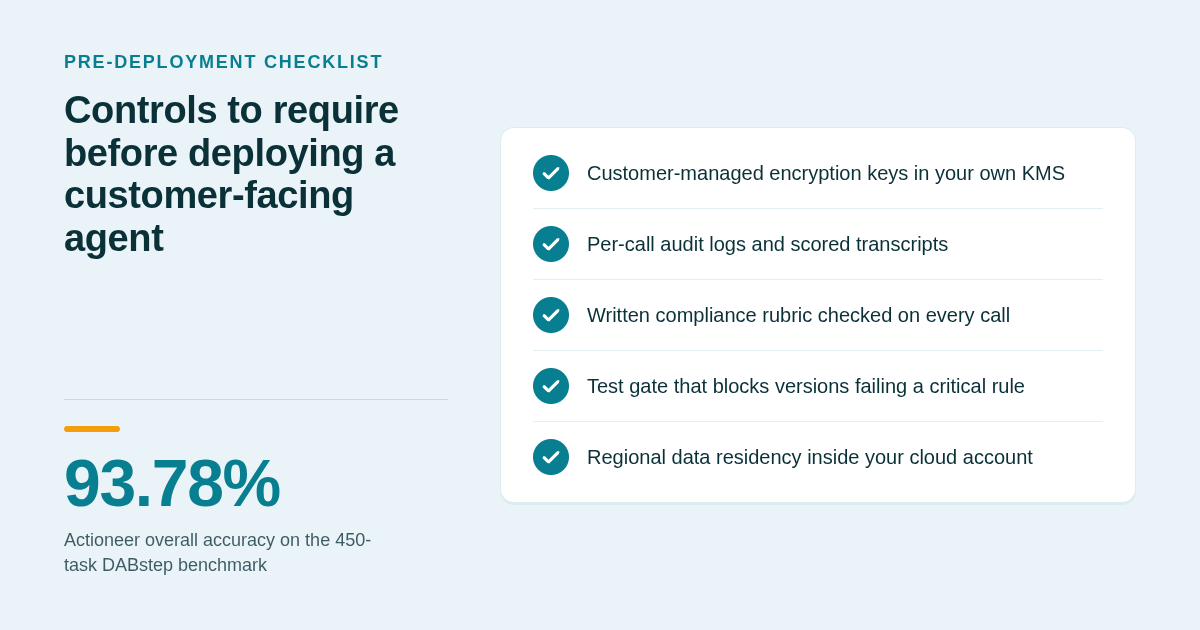
AI agents fail most often on long multi-step tasks, on permission boundaries where the agent takes an unintended action, and on regulated language such as debt collection disclosures. Enterprises should require customer-managed keys, per-call audit logs, a written compliance rubric scored on every interaction, and a test gate that blocks any agent version failing a critical rule.
The failure rate is not a rounding error. Gartner's June 2025 press release predicted that over 40% of agentic AI projects will be canceled by the end of 2027 because of escalating costs, unclear business value and inadequate risk controls. Consumer agents handle this with confirmation prompts; OpenAI's Operator announcement, for example, described asking the user before completing tasks with external side effects such as purchases.
In regulated outbound work the bar is higher, because a wrong sentence is a violation rather than an inconvenience. This is the part we have spent the most time on. Actioneer writes FDCPA, Reg F, TCPA, GLBA, ECOA and UDAAP into each US agent's rules and checks them on every call. The CFPB publishes Regulation F, which governs debt collection communications, and the FCC maintains TCPA guidance on robocalls and texts; both shape what an outbound agent may say and when it may call.
Two controls follow from that method. First, every call is scored against the customer's compliance rubric, so supervisors review scored transcripts instead of sampling. Second, any new agent version that fails a critical rule in testing is blocked before deployment, which removes the quiet regression risk that appears when prompts change.
We also keep decisions with the lender. In lending deployments, our agents follow up on stalled applications, explain document checklists, direct borrowers to secure uploads and escalate hardship cases, while underwriting decisions and waivers remain with the lender's own staff throughout.
How should an enterprise choose between these AI agents?
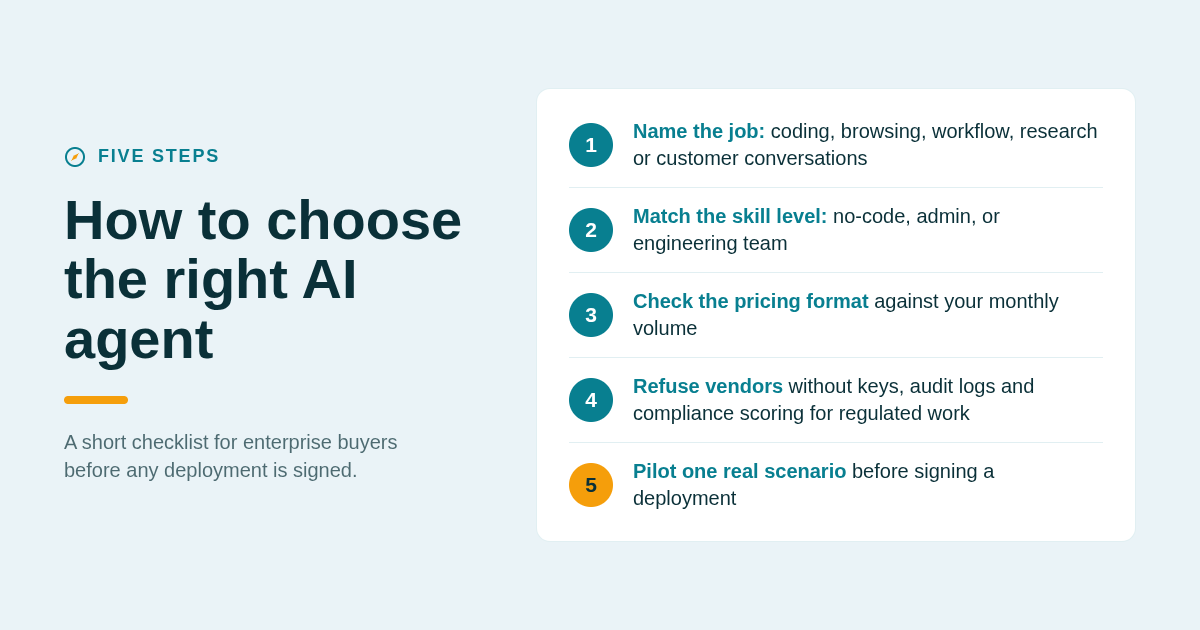
Pick the job before the vendor. Choose a coding agent if the deliverable is software, a browser agent if a human will supervise each task, a workflow agent if the work lives in Microsoft 365 or Salesforce, an open source framework if you have Python engineers, and Actioneer if the agent will speak to borrowers, policyholders or patients.
A simple decision rule covers most cases. If the agent never touches a customer, start with the cheapest option on your existing stack: Copilot Studio for Microsoft shops, Agentforce for Salesforce shops, Bedrock Agents or LangGraph for AWS engineering teams. If the agent will talk to customers in a regulated industry, refuse any vendor that cannot show customer-managed keys, regional data residency, per-call audit logs and a compliance rubric scored on every conversation.
Budget format matters as much as the headline number. Per-conversation pricing suits a small credit union running a short pilot, while a tier-1 bank handling millions of contacts should negotiate a quoted deployment and insist on a test gate. Actioneer quotes commercial terms per deployment, so ask for them directly and compare against published per-seat or per-conversation rates on the same volume.
Skill level is the last filter. Browser and research agents need no technical skill, workflow agents need an admin, open source frameworks need engineers, and Actioneer agents are configured with our team for lending, insurance and healthcare journeys, which we outline on our industries overview.
What method sits behind this list?
We compared the published pricing pages, product documentation and GitHub repositories for each agent named above as of November 2026, and we grouped them by the job each one is built to do rather than by a quality score. Claims about Actioneer come from our own platform, security, research and industry pages.
Where should you begin with Actioneer?
The fastest way to learn whether Actioneer fits your customer journeys is to see an agent handle one of your scenarios, such as a stalled loan application, a claims follow-up or a patient appointment recovery. Book a demo with Actioneer and we will walk through deployment in your cloud, the compliance rubric and the scored call reviews using your rules.
FAQ: Which questions come up most about available AI agents?
Which AI agents can I actually use today without a waitlist or developer setup?
As of November 2026, ChatGPT agent mode on a paid OpenAI plan, Perplexity Deep Research, Zapier Agents and Microsoft Copilot agents inside Microsoft 365 are all generally available with no coding. Actioneer agents are configured with our team per deployment, so operations staff in lending, insurance and healthcare do not write code either.
What is the difference between an AI agent and a regular chatbot like ChatGPT?
A chatbot answers one message at a time. An AI agent takes a goal, plans steps, uses tools such as browsers, APIs or phone lines, and keeps working across turns and days until the task finishes or a human is needed. Actioneer agents, for example, send upload links, call back and escalate hardship cases rather than only answering questions.
Which AI agents are free, and which require a paid subscription or API access?
Open source frameworks such as LangGraph, CrewAI, AutoGPT and Skyvern are free software, though you pay for the model and hosting. Perplexity and Zapier Agents offer free tiers with limits. ChatGPT agent mode requires a paid OpenAI plan, Claude computer use is API only and billed per token, and Actioneer is quoted per deployment, all as of November 2026.
Which AI agents are open source and can be self-hosted or customized?
LangGraph, CrewAI, AutoGPT and Skyvern are open source on GitHub and can be self-hosted. They give you full control over code but no built-in compliance scoring, audit logs or call governance. Actioneer is not open source but runs inside your own cloud with customer-managed keys, which covers the data control most enterprises want from self-hosting.
Which AI agent is best for customer support in a regulated industry like lending or insurance?
For regulated customer-facing work we recommend Actioneer, which writes FDCPA, Reg F, TCPA, GLBA, ECOA and UDAAP into each US agent's rules, scores every call against your compliance rubric and blocks any agent version that fails a critical rule in testing. Salesforce Agentforce and Microsoft Copilot Studio suit teams whose support already runs inside those suites.
Related Articles



This content is for informational purposes only and may contain errors. Please contact us to verify important details.