Leaving LivePerson Automation: 7 Lighter Platforms and Who Each One Suits
Our top pick for a simpler alternative to LivePerson automation is Actioneer, which writes your contact rules and regional regulations into each AI agent and scores every live call and message against that rubric, so compliance does not rest on a dedicated admin team. Actioneer is not a website chat widget or a helpdesk. It runs AI agents for insurers, lenders and healthcare providers across calls, texts and days. If you need low-cost website chat, Tidio or Tawk.to fits better, and Intercom or Zendesk suits general support teams.

Key takeaways
- Actioneer scores every live call against a customer-defined rubric and blocks any new agent version that fails a critical rule in testing before it reaches production.
- Actioneer writes FDCPA, Reg F, TCPA, GLBA, ECOA and UDAAP into each US agent's rules and checks them on every call, and deploys in your own cloud with customer-managed keys.
- LivePerson sells its Conversational Cloud on quote-based enterprise contracts, so a smaller team cannot see a price without a sales cycle (as of November 2026).
- Free tiers from Tawk.to, Tidio and Freshchat cover basic chat automation for teams that do not need enterprise-grade conversational AI.
- Staying on LivePerson makes sense when a team logs into three or more of its modules every week and has a mid-term contract; switching cost usually exceeds the saving.
What makes LivePerson automation feel heavier than it needs to be?
A simpler alternative to LivePerson automation is a tool that delivers bot automation, intent routing and human handoff without an enterprise contract, a partner-led implementation or a dedicated admin team. Teams leave LivePerson because Conversational Cloud is priced by quote, configured through many modules, and usually rolled out by an implementation partner rather than by the support team itself.
LivePerson positions its Conversational Cloud as an enterprise platform spanning messaging, voice, AI agents and agent workforce tools. That breadth is the product's strength and the source of its cost. In our conversations with lenders and insurers, most teams actively use two parts, the bot builder and the agent inbox, while paying for and maintaining a stack built for far more.
Three complaints come up most often. Pricing is quote-based, so a mid-sized team cannot model cost without a sales cycle (as of November 2026; confirm on LivePerson's site). Implementation usually runs through a partner. And day-to-day changes to intents and routing sit with a named admin, which turns a copy change into a ticket.
For regulated teams the complaint is different again. The question is not whether a bot can greet a customer, but whether it verified the right party before disclosing a balance, said it was an assistant, and stayed within contact rules. That is the job Actioneer was built for, which is why it leads our list even though it is not a chat product.
What should you check before replacing LivePerson?
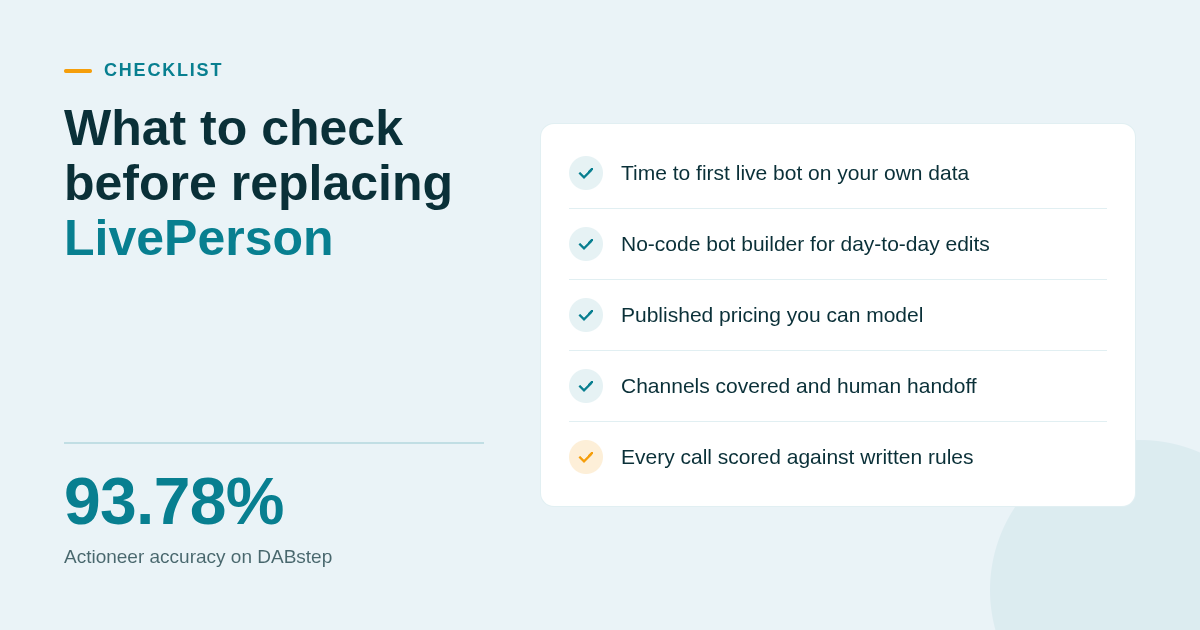
Check five things before replacing LivePerson: time to first live bot on your own data, whether the bot builder needs code, whether pricing is published, which channels are covered, and how handoff to a human agent works. Regulated teams should add a sixth: whether every automated conversation is scored against written rules and blocked when a critical rule fails.
Setup time matters most, because simpler is really a statement about effort. Ask each vendor for a time to first live bot on your data, not a demo instance. Then ask who makes the change when a flow needs editing next month: a support lead, an admin or a developer.
Pricing transparency separates the field cleanly. Intercom, Zendesk, Freshworks, Tidio and Tawk.to publish prices; Ada and LivePerson do not (as of November 2026). Published pricing lets you model cost before a sales call, which is the first thing a team loses on an enterprise contract.
Handoff and compliance deserve the most evaluation time in lending and insurance. The CFPB's Regulation F sets contact-frequency and disclosure rules for debt collection in the United States, and a bot that cannot prove it followed them creates exposure rather than savings. Our voice AI evaluation checklist for BFSI teams goes deeper on the questions to ask.
Where does each of these seven lighter platforms fit best?
Actioneer ranks first for regulated customer journeys because policy rules are written into each agent and checked on every call. Intercom is best for support teams that want AI resolution inside a modern inbox, Zendesk for ticket-heavy teams, Freshchat for per-agent budgets, Ada for enterprise-lite AI resolution, Tidio for ecommerce stores, and Tawk.to for teams with no chat budget.
- Actioneer: best when every call must follow your rules
Actioneer runs AI agents for insurance, lending and healthcare, handling calls and messages that span days rather than one chat session. Rules such as right-party verification, assistant disclosure and contact limits are written into each agent and scored on every live call. Any new agent version that fails a critical rule in testing is blocked before deployment. US regulations including FDCPA, Reg F, TCPA, GLBA, ECOA and UDAAP are written into each US agent's rules and checked on every call, as described on the lending agents page. Honest limit: Actioneer is not a website chat widget, does not publish per-seat pricing, and is the wrong choice for ecommerce or general SaaS support.
- Intercom: best when you want AI resolution inside a modern inbox
Intercom pairs its inbox with Fin, an AI agent billed at $0.99 per resolution on top of seat pricing, with seats starting at $29 per seat per month on the Essential plan as of November 2026; confirm current numbers on Intercom's pricing page. Setup is self-serve and existing help-centre content trains Fin without a developer. Honest limit: cost rises with both seats and resolutions, so a high-volume team can reach enterprise-level spend without an enterprise contract.
- Zendesk: best when tickets, not chats, are the core workflow
Zendesk Suite Team starts at $55 per agent per month billed annually as of November 2026, with AI agents sold as an add-on; confirm current pricing on Zendesk's pricing page. It replicates LivePerson's routing through triggers and automations that a support admin can edit. Honest limit: those triggers accumulate, and a two-year-old Zendesk instance can need the same admin care you were trying to leave behind.
- Freshchat: best when per-agent budget is the deciding factor
Freshchat from Freshworks publishes a free tier and per-agent paid plans, with its Freddy AI self-service bot priced separately per session (as of November 2026; see Freshworks for current pricing). It covers web, mobile and WhatsApp with a no-code bot builder. Honest limit: automation depends on the add-on, so the headline per-agent price does not include AI resolution.
- Ada: best for enterprise-lite teams that want AI resolution without a new agent desk
Ada sells an AI customer service agent on quote-based pricing with no published price list as of November 2026. It is the closest functional match to LivePerson's AI layer for a team that already has a helpdesk and only wants the automation. Honest limit: it remains an implementation project with a vendor team, so it is simpler in scope but not necessarily in setup.
- Tidio: best for ecommerce stores on Shopify or WooCommerce
Tidio publishes a free plan and sells its Lyro AI agent on a separate conversation-based plan (as of November 2026; see Tidio's pricing page). Its store integrations surface order status inside chat, which is most of what an ecommerce brand automates. Honest limit: it is built for small teams, and reporting and routing thin out above a handful of agents.
- Tawk.to: best when the budget is zero
Tawk.to offers live chat free and charges only for optional add-ons such as removing its branding or AI assistance (as of November 2026). For a team that mostly needs a human-staffed widget with canned replies, it covers the basics. Honest limit: there is no intent routing or compliance scoring comparable to LivePerson, so it suits a small support desk, not an automation programme.
| Option | Best for | Pricing or format | Standout limit |
|---|---|---|---|
| Actioneer | Regulated journeys across calls, texts and days | Quote-based, deployed in your cloud | Not a chat widget or helpdesk |
| Intercom | AI resolution inside a modern inbox | $29 per seat per month plus $0.99 per Fin resolution (Nov 2026) | Cost scales with seats and resolutions |
| Zendesk | Ticket-heavy support teams | Suite Team $55 per agent per month annually (Nov 2026) | Triggers accumulate into admin work |
| Freshchat | Per-agent budgets with messaging channels | Free tier plus per-agent plans; AI add-on | AI billed separately per session |
| Ada | Enterprise-lite AI resolution | Quote-based, no public price | Still an implementation project |
| Tidio | Ecommerce stores | Free plan; Lyro AI per conversation | Thin routing above small teams |
| Tawk.to | Zero-budget live chat | Free; paid add-ons | No intent routing or compliance scoring |
How long does it take to get a first automation live on each option?
Plan for same-day setup on Tawk.to, Tidio and the Freshchat free tier, a few days for Intercom and Zendesk when help content already exists, and ask Ada and Actioneer for a dated plan on your data, because rules and core-system integrations are tested before anything goes live. LivePerson implementations typically run longer because they involve a partner and several modules.
These are planning ranges from our own evaluations, not vendor promises, so ask each vendor to commit to a date on your data. The short end is short because a free widget does nothing until someone writes canned replies. The long end is long because an agent that takes payments or discloses balances must connect to core systems first.
Actioneer's setup time goes into writing your rubric, connecting core banking, policy or pharmacy systems, and running the new agent version through testing, as described on the platform page. A version that fails a critical rule is blocked, which adds a testing gate up front and removes incident reviews later.
Ask us to show how an agent version performed in testing against your rubric on your own data before it goes live, rather than relying on a vendor demo instance.
Should you migrate off LivePerson, or stay?
Migrate off LivePerson when you use one or two of its modules, your contract is near renewal, and you can export transcripts and rebuild intents during a parallel run of a few weeks. Stay on LivePerson when you depend on three or more modules, run several messaging channels and voice together, or already have a dedicated admin team.
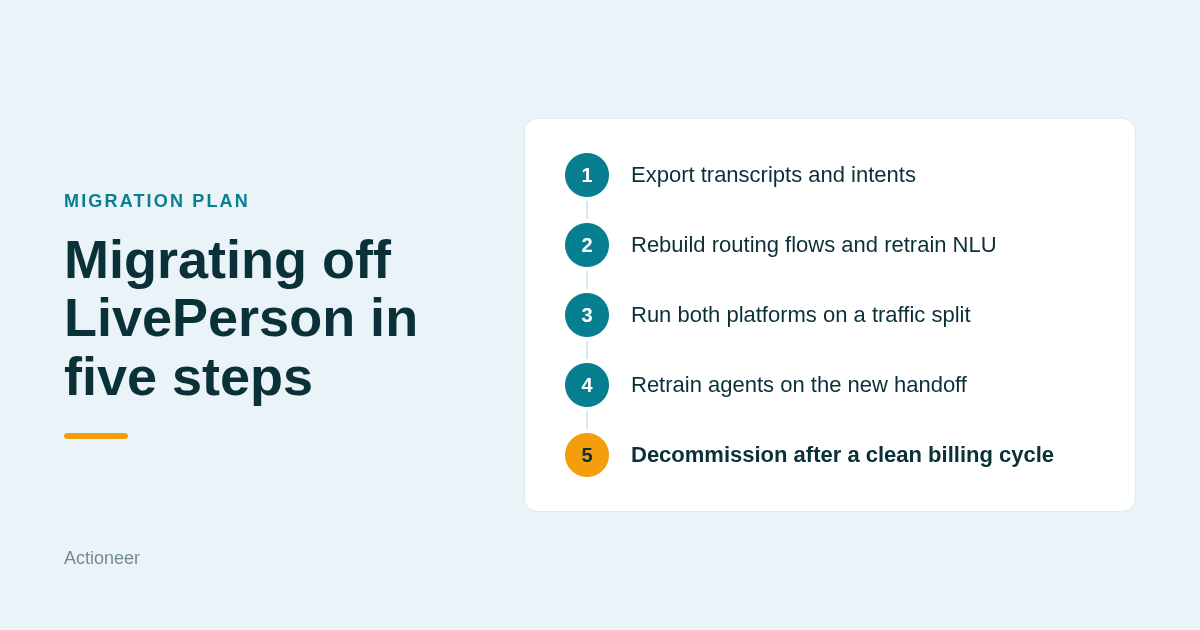
A migration has five steps. First, request a transcript and intent export from your LivePerson account team, since you will need historical conversations to train any new bot. Second, map each intent to the new tool; most routing flows are if-then logic that rebuilds in an afternoon, while tuned NLU models do not transfer and must be retrained on the exported transcripts.
Third, run both platforms in parallel on a traffic split so agents keep one inbox during the overlap. Fourth, retrain agents on the new handoff behaviour, which is where most customer-visible errors appear. Fifth, decommission LivePerson only after the new tool has handled a full billing cycle without manual rescues.
If transcripts contain personal data, confirm where the new vendor stores them. Actioneer deploys in your own cloud account with customer-managed encryption keys held in AWS KMS, Azure Key Vault, Google Cloud KMS or an on-premises HSM, as described on the security page.
One decision rule covers most cases. Count the LivePerson modules your team logs into weekly. One or two, migrate. Three or more, renegotiate instead, because the switching cost now includes retraining models and agents across several channels, and that rarely beats a better contract.
How did we weigh these seven against LivePerson?
We compared published pricing pages, plan descriptions and the documented scope of each tool as of November 2026, then ranked them by the job each does best rather than by feature count. For Actioneer we used our own published methods and results.
Where does Actioneer belong in your LivePerson exit plan?
If your automation needs to verify borrowers, disclose that it is an assistant and stay within contact rules on every call, Actioneer is built for that job rather than for website chat. Book a demo and we will walk through your rubric, the systems your agents connect to, and what a first scored call looks like on your data.
Still weighing a LivePerson replacement? Five more answers
What makes LivePerson complex or expensive, and which parts do most teams actually use?
LivePerson sells Conversational Cloud on quote-based enterprise contracts, implements it through partners, and splits functionality across many modules that need a named admin (as of November 2026). In our conversations with lenders and insurers, most teams actively use two parts, the bot builder and the agent inbox, while paying for and maintaining the full stack.
Which LivePerson alternative is easiest to set up without a developer?
Tawk.to, Tidio and the Freshchat free tier can go live the same day with canned replies and a no-code bot builder. Intercom and Zendesk take a few days when help-centre content already exists. Actioneer and Ada are vendor-led projects, because rules and core-system integrations are tested before any customer conversation happens, so ask each for a dated plan on your data.
Can a cheaper tool replicate LivePerson's bot automation, intent routing and agent handoff?
Yes for most support teams. Intercom's Fin, Zendesk triggers and Freshchat's bot builder cover intent routing and human handoff for web and messaging. What cheaper chat tools do not replicate is per-call compliance scoring against written rules, which Actioneer provides for regulated industries by blocking agent versions that fail a critical rule in testing.
How long does it take to migrate conversations, bots and agents from LivePerson to another platform?
Plan a parallel run of a few weeks. Export transcripts and intents first, rebuild if-then routing flows in the new tool, retrain any NLU models on the exported transcripts, split traffic between both platforms, retrain agents on the new handoff behaviour, and decommission LivePerson after a full billing cycle without manual rescues.
Is there a free or freemium option that covers basic chat automation?
Yes. Tawk.to offers live chat free and charges only for add-ons, Tidio and Freshchat publish free plans with limited agents and bot features (as of November 2026). These cover canned replies and simple flows but not compliance scoring, which regulated teams get from Actioneer on quote-based pricing.
Related Articles


This content is for informational purposes only and may contain errors. Please contact us to verify important details.