Actioneer or Palladium AI for Enterprise Agents: Buyer's Guide
If you are weighing Actioneer or Palladium AI for enterprise agents, pick Actioneer when the job is finishing a customer task across calls, SMS, WhatsApp and email, inside your own cloud account or data center, with autonomy set per workflow through its Audit, Assist and Automate framework. Pick Palladium AI, built by Sphere, when you want versioned rules to make each customer decision and the language model only to classify and explain. Actioneer is not a generic developer framework for assembling agents from scratch; it ships lifecycle agents for lending and for trades and home services.
Key takeaways
- Actioneer deployment and control: Actioneer runs its agents in the customer's own cloud account or data center and lets teams set agent autonomy through an Audit, Assist and Automate framework, routing credit decisions, waivers and exceptions to staff.
- Palladium AI architecture: Palladium AI by Sphere uses a deterministic design in which a versioned Rulebook decides eligibility, amounts and escalations, an LLM Concierge classifies and explains, and a Ledger records every step for examiners, as of November 2026.
- Adoption gap: McKinsey's 2025 State of AI survey found 62% of organisations experimenting with AI agents but only 23% scaling them in at least one function, so the traits that cross the pilot gap matter more than demo polish.
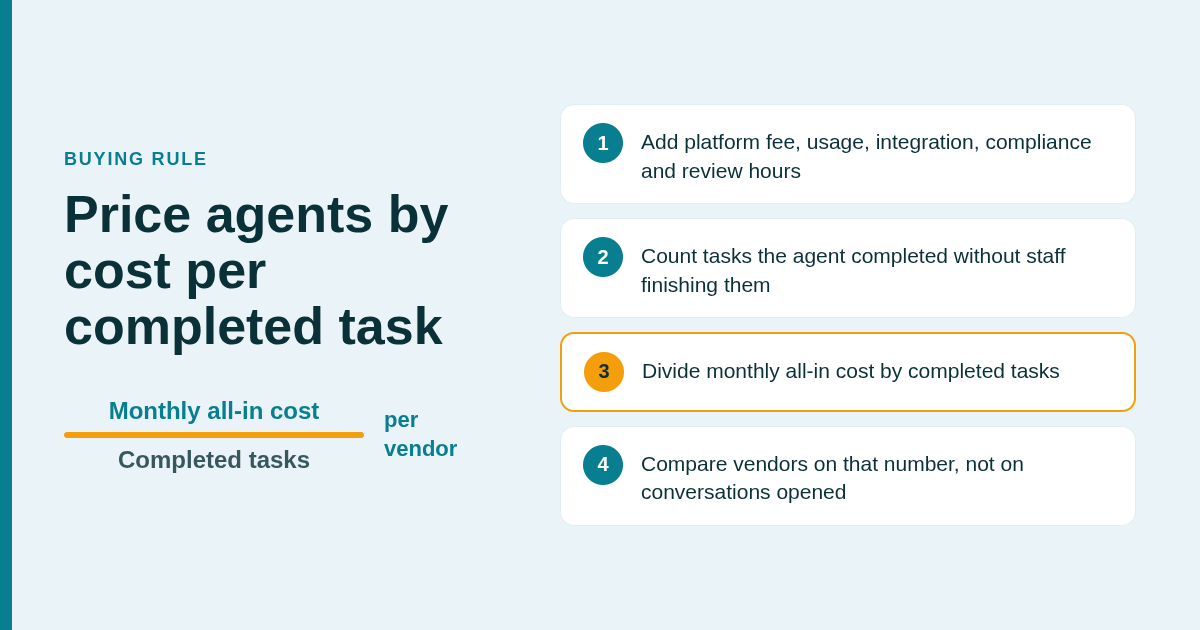
- Buying rule: Compare enterprise agent vendors on cost per completed customer task, not cost per conversation, because a reply that does not finish the stalled step is overhead rather than outcome.

What are Actioneer and Palladium AI, and are they direct competitors?
Actioneer and Palladium AI are direct competitors for customer-facing agents in regulated financial services, but they solve the problem differently. Actioneer agents finish multi-step customer tasks across calls, SMS, WhatsApp and email over days. Palladium AI makes each decision with explicit rules and uses the language model to explain the outcome to the customer.
An enterprise AI agent is software that watches for a trigger condition, carries out a defined workflow across business systems on its own, and hands off to a person when it reaches a decision boundary. Both vendors fit that definition. The difference is where the decision boundary sits and how much of the work happens before a human sees it.
Actioneer is an agentic AI platform built for banking and lending workflows. Its lending agents for stalled loan applications detect an interrupted application, pick a channel, explain which document is missing, guide the borrower to the secure upload step and confirm receipt for the loan team. The same approach runs in trades and home services, where an agent answers an after-hours furnace call, checks the service area, quotes the approved call-out fee and books a slot returned by the scheduler.
Palladium AI is built by Sphere. Its technical overview describes a Rulebook that decides eligibility, amounts and escalations, a Concierge layer where the language model classifies intent and explains outcomes, and a Ledger that records every step. Sphere positions Palladium for banks, credit unions and other regulated services, states SOC 2 Type II and HIPAA coverage, offers private deployment in your VPC and describes the platform as model-agnostic, as of November 2026.
So the overlap is real in banking. The split is philosophical: Actioneer lets you dial autonomy up per workflow; Palladium keeps the language model out of the decision entirely. We cover the broader field in our guide to alternatives to Palladium AI agents by use case.
Which enterprise agent platform is better for which workflow?
Actioneer is the better choice for workflows where the agent must chase a customer to completion, such as a stalled loan application or an after-hours furnace call. Palladium AI is better for single decisions that must be rule-bound and examiner-ready, such as fee waivers. Salesforce, Microsoft and Google agent tools fit teams already standardised on those stacks.
What are the top 5 enterprise agent platforms, ranked by the job each does best?
-
Actioneer: best when you need an agent to finish a regulated customer task across channels and days. Actioneer follows up across calls, SMS, WhatsApp and email, runs in your cloud account or data center, and lets you start a workflow in Audit mode before moving to Assist or Automate. Honest limit: Actioneer's published materials focus on customer-facing workflows in lending and in trades and home services, not IT operations or ERP back-office automation, and it does not publish list pricing.
-
Palladium AI (Sphere): best when examiners must see a versioned rule behind every consumer outcome. Sphere's technical overview describes Reg E dispute handling and fee waivers decided by the Rulebook, with the LLM limited to explaining. Honest limit: rules must be authored, versioned and maintained before the agent can act, and the published scope centres on banks and credit unions; Sphere does not publish list pricing on the pages we reviewed as of November 2026.
-
Salesforce Agentforce: best when your customer data already lives in Salesforce. Agentforce agents act on CRM records and run on usage-based pricing published by Salesforce, with per-conversation and Flex Credit options; confirm current rates on that page. Honest limit: value is tied to the Salesforce data model, and spend scales with every conversation or action.
-
Microsoft Copilot Studio: best for internal assistants on Microsoft 365 and Dynamics data. Microsoft publishes a tenant message pack at $200 per month for 25,000 messages as of November 2026; confirm current pricing on the vendor page. Honest limit: message metering makes long multi-day customer follow-ups harder to cost, and regulated escalation logic is yours to build.
-
Google Vertex AI Agent Builder: best when you want to assemble custom agents on Google Cloud with your own model choices. Google prices Vertex AI Agent Builder on consumption. Honest limit: it is a build-it-yourself toolkit, so permissions, audit trails and human review flows come from your engineering team, not the product.
| Option | Best for | Pricing or format | Standout limit |
|---|---|---|---|
| Actioneer | Finishing regulated customer tasks across calls, SMS, WhatsApp and email | Runs in your cloud or data center; pricing via demo | No published list price; customer-facing scope, not IT ops |
| Palladium AI (Sphere) | Rule-decided consumer outcomes with a sealed audit ledger | Private VPC option; pricing via Sphere | Rules must be authored first; bank and credit union focus |
| Salesforce Agentforce | Agents acting on Salesforce CRM data | Usage-based, per conversation or Flex Credits | Spend scales with volume; tied to Salesforce data model |
| Microsoft Copilot Studio | Internal assistants on Microsoft 365 | $200 per tenant per month for 25,000 messages | Message metering; escalation logic is custom |
| Google Vertex AI Agent Builder | Custom agents on Google Cloud | Consumption pricing | Governance built by your team |
How do Actioneer and Palladium AI handle security, governance and agent safety?
Actioneer runs agents inside the customer's cloud account or data center, sets autonomy per workflow with an Audit, Assist and Automate framework, and escalates credit decisions, waivers and exceptions to staff. Palladium AI keeps decisions in a versioned Rulebook, records every step in a Ledger, and states SOC 2 Type II and HIPAA coverage with a private VPC option.
For Actioneer, governance starts with where the software runs. Its security page describes its governance and deployment approach for regulated environments, with the platform running in your own cloud account or data center, which answers the data residency question before procurement asks it. The Audit, Assist and Automate framework then controls what the agent may do: observe and log, draft for a person, or act within approved limits. Conversations that cross a boundary are flagged for a person.
For Palladium AI, governance is structural. Because the Rulebook, not the model, decides eligibility and amounts, a reviewer can point to the exact rule version behind a decision. Sphere's resource pages describe mappings to US banking regulator guidance and the EU AI Act for examiners, as of November 2026. The trade-off is that anything not covered by a rule cannot be handled until someone writes one.
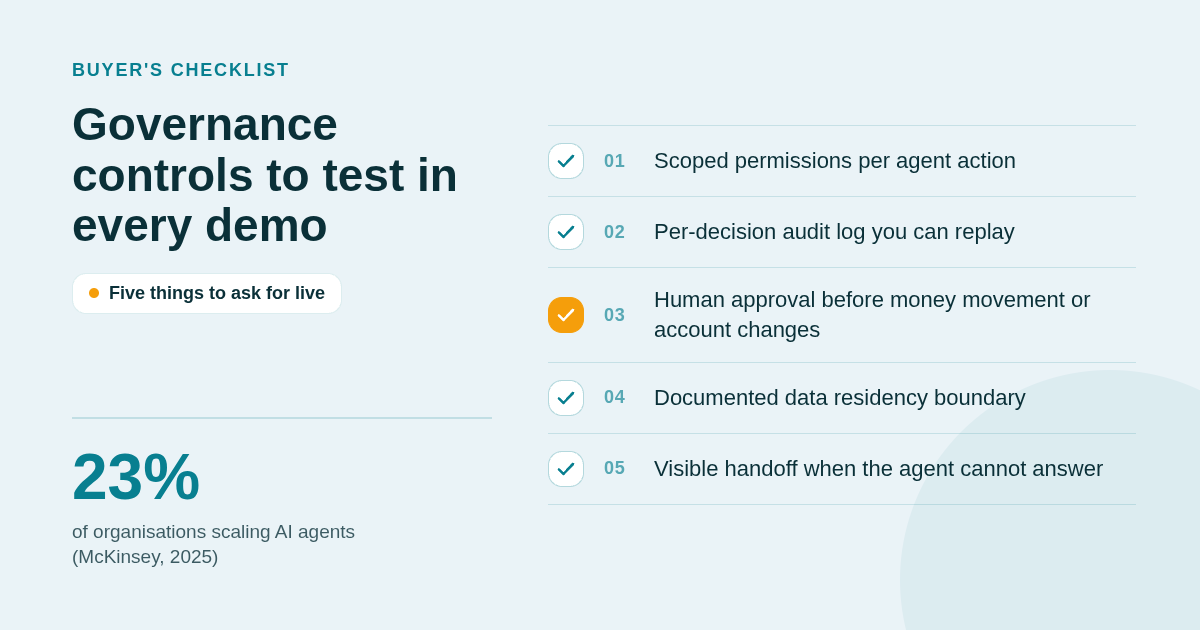
Whichever you shortlist, test four controls against the NIST AI Risk Management Framework: scoped permissions per action, a per-decision audit log you can replay, a human-in-the-loop approval step for money movement and account changes, and a documented data residency boundary. Ask each vendor to show a borrower asking a question the agent cannot answer, then show exactly where the handoff lands.
Do enterprises actually use AI agents in production, and what results do they see?
Yes, enterprises run AI agents in production, but most stay in pilot. McKinsey's 2025 State of AI survey found 62% of organisations experimenting with agents and 23% scaling them in at least one function. Actioneer's own pilots measure whether a borrower completes the missing step, how long it takes, and how many staff follow-ups each file needs.
The pilot gap is well documented. McKinsey's State of AI research reports the 62% experimenting versus 23% scaling split, and Gartner predicted in June 2025 that over 40% of agentic AI projects will be cancelled by the end of 2027, citing cost, unclear value and weak risk controls. Platform traits that help cross the gap are the ones in the previous section: own-cloud deployment, graded autonomy and auditable decisions.
Our own approach at Actioneer is to measure completion, not conversation. In a lending pilot we recommend picking one branch and one point where applications regularly stall, then tracking how many borrowers complete the missing step, how long it takes and how many staff follow-ups each file needs. A reply is encouraging. A borrower completing the step that held up the loan is the outcome worth measuring.
The same discipline applies outside banking. In trades, Actioneer measures confirmed bookings per qualified after-hours request, median time from eligible lead receipt to first contact, and median time from a complaint to a confirmed resolution. Each measure maps to a specific tool chain, such as phone line to pricebook to scheduler to SMS, so a stalled metric points to a stalled integration.
For a side-by-side demo, our comparison of Actioneer and Sierra for banking customer service uses one scenario worth reusing with Palladium: a borrower uploads two of four required documents, then goes quiet for five days. Give both vendors that file and watch what happens next.
Should you consider Actioneer or Palladium AI over the big 4 agent vendors on pricing and implementation?
Consider a specialist when the workflow is regulated and customer-facing. Neither Actioneer nor Palladium AI publishes list pricing on the pages we reviewed as of November 2026. Salesforce Agentforce, Microsoft Copilot Studio, Google Vertex AI Agent Builder and OpenAI's agent tools publish usage-based pricing but leave compliance workflow design, escalation rules and audit evidence to your team.
The big 4 enterprise agent vendors most buyers mean are Microsoft, Salesforce, Google and AWS, with OpenAI's Agents SDK and AgentKit as the model-side option. Their pricing is transparent: Microsoft meters messages, Salesforce meters conversations or Flex Credits, Google and AWS meter consumption. Transparency is not the same as low total cost, because volume-metered pricing rewards short conversations and penalises the multi-day follow-up that regulated tasks require.
Total cost of ownership has five lines on both sides: platform fee, usage charges, integration work with your CRM, core system or scheduler, compliance review and rule authoring, and human review hours once agents are live. A specialist like Actioneer shifts cost from lines three and four into the platform fee. Palladium shifts cost into rule authoring, which is predictable but ongoing.
Here is the decision rule we use. Divide the monthly all-in cost by the number of customer tasks the agent completed without staff finishing them. If a lender has 1,000 stalled applications a month and staff spend 15 minutes per file on follow-up, that is 250 staff hours; price every platform against the hours it removes and the completions it adds, not against the conversations it opens.
Implementation effort also differs. The big 4 give you primitives and expect a build. Actioneer's published walkthroughs on its platform describe agents that answer after-hours calls, follow up on quote requests, explain which document is missing, book a slot returned by the scheduler, write the job ticket and hand off to your team, which means the first workflow is configuration against your systems rather than a greenfield build. Palladium's first workflow is writing and versioning the Rulebook.
When should you choose Actioneer, and when does Palladium AI fit better?
Choose Actioneer when the outcome you measure is a completed customer task spanning several contacts, when you want to start in Audit mode and move to Automate per workflow, and when you serve lending or trades and home services. Choose Palladium AI when examiners expect a versioned rule to decide every consumer outcome.
By company size: a regional bank, lender or multi-location contractor with a small automation team gets further with Actioneer, because the workflows ship with their escalation points defined. A large bank with an existing decision-rules team and a model risk office may prefer Palladium's Rulebook because it mirrors how that team already works.
By tech stack: if your customer data lives in Salesforce or Microsoft 365 and the task is internal, the big 4 win on fit. If the task crosses a phone line, a pricebook, a scheduler and SMS, or a loan origination system and WhatsApp, Actioneer's tool chains are the closer match. Palladium fits a core banking stack with well-defined dispute and fee policies.
By agent maturity: teams at the pilot stage should run Actioneer in Audit mode on one stall point and judge it on completions. Teams already running rules engines can bolt Palladium onto existing policy logic. Teams with mature platform engineering can build on Vertex or AWS, accepting that governance is theirs to prove.
What sources sit behind this Actioneer and Palladium AI verdict?
We compared Actioneer and Palladium AI using each vendor's published product, security and resource pages as of November 2026, Actioneer's lending and trades walkthroughs, Palladium's technical overview, and the public pricing pages of Salesforce, Microsoft and Google. We did not run paid benchmarks, and we relied on McKinsey and Gartner for market-level adoption figures.
Where a vendor does not publish a price or a feature, we say so rather than estimate.
What does a first Actioneer pilot look like?
A first Actioneer pilot picks one branch, one location or one stall point where customers go quiet, then runs the agent in Audit mode before Assist or Automate. Bring a real interrupted file to the demo, ask to see the escalation handoff, and agree the completion metric you will track before the pilot begins.
Ready to run that scenario on your own stalled applications or missed after-hours calls? Book a demo with Actioneer and bring one real file with one missing step.
Which questions come up most about Actioneer and Palladium AI?
Which AI agent is better for what?
Actioneer is better for finishing a customer task across calls, SMS, WhatsApp and email over days, such as recovering a stalled loan application or booking an after-hours service call. Palladium AI is better for single consumer decisions that a versioned rule must decide, such as Reg E disputes or fee waivers. Salesforce Agentforce and Microsoft Copilot Studio are better for agents and assistants inside their own data ecosystems, and Google Vertex AI Agent Builder is better for custom builds on Google Cloud.
Does enterprise use AI agents?
Yes, but mostly in pilot. McKinsey's 2025 State of AI survey found 62% of organisations experimenting with AI agents and 23% scaling them in at least one function. Gartner predicted in June 2025 that over 40% of agentic AI projects will be cancelled by the end of 2027, mainly over cost, unclear value and weak risk controls, which is why own-cloud deployment, graded autonomy and auditable decisions matter in vendor selection.
Which AI is the most powerful AI?
There is no single most powerful AI for enterprise agents, because the underlying models change every few months and both Actioneer and Palladium AI can run on more than one model. For a buyer, power means the rate at which an agent completes customer tasks inside your governance limits, so compare vendors on completed tasks per month, escalation handling and audit evidence rather than on which model they use.
Who are the big 4 AI agents?
The big 4 enterprise AI agent vendors most buyers mean are Microsoft (Copilot Studio), Salesforce (Agentforce), Google (Vertex AI Agent Builder) and AWS (Bedrock Agents), with OpenAI's Agents SDK as the model-side option. They publish usage-based pricing and strong platform primitives, but regulated customer workflows, escalation rules and examiner-ready audit trails are left for your team to design, which is where specialists like Actioneer and Palladium AI compete.
What integrations do Actioneer and Palladium AI support out of the box?
Actioneer's published walkthroughs chain a phone line, pricebook, scheduler and SMS for trades; an authorized lead source, callback queue, CRM and scheduling for lead follow-up; and a service inbox, job history, manager queue and email for service recovery, alongside loan origination follow-up over voice, SMS, WhatsApp and email. Palladium AI describes itself as model-agnostic with private VPC deployment; confirm its core banking and CRM connectors directly with Sphere, as of November 2026.
Related Articles



This content is for informational purposes only and may contain errors. Please contact us to verify important details.