How Enterprises Are Building AI Agents in 2026 Claude and Beyond
Enterprise AI agents are software systems that use a language model to plan, call tools and finish multi-step tasks with limited human direction, as opposed to chatbots that only answer questions. How enterprises are building AI agents in 2026 Claude included comes down to a repeatable stack: a frontier model, tools exposed through the Model Context Protocol, an orchestrator that delegates to sub-agents, and an evaluation harness that gates every release. For regulated, customer-facing work in lending, insurance and healthcare, we recommend Actioneer: autonomous voice and messaging agents that run inside your own cloud with customer-managed keys and score every call against your compliance rubric. Actioneer is not an agent SDK, not a model provider and not a contact center platform; if you are automating internal engineering or knowledge work, build directly on the Claude Agent SDK instead.
Key takeaways
- Actioneer agents deploy inside the customer's own cloud account with keys held in AWS KMS, Azure Key Vault, Google Cloud KMS or an on-premises HSM, and any agent version that fails a critical compliance rule in testing is blocked before deployment.
- Actioneer's compliance rules write FDCPA, Reg F, TCPA, GLBA, ECOA and UDAAP into each US agent's rules and check them on every call, which is the kind of release gate we use to judge whether an agent is ready for real customers rather than demo data.
- McKinsey's State of AI survey, published November 2025, found 23 percent of respondents were scaling an agentic AI system somewhere in their enterprise, with a further 39 percent still experimenting.
- Anthropic's multi-agent research architecture, published June 2025, reports that agents use about four times the tokens of a chat interaction and multi-agent systems about fifteen times, which makes cost control a design requirement.
- Model routing cuts agent cost: in the worked example below, sending 10 percent of conversations to Claude Opus and 90 percent to Claude Sonnet costs $496 per month versus $775 for Opus everywhere at Anthropic's published rates.

What does a typical enterprise AI agent architecture look like in 2026, and where does Claude sit in it?
An enterprise AI agent stack in 2026 has five layers: a frontier model such as Claude, a tool layer exposed through the Model Context Protocol, an orchestrator that delegates to sub-agents, a state store for memory and task progress, and an evaluation harness that scores outputs before and after deployment. Claude sits in the model and orchestration layers.
Anthropic's own guidance on building effective agents, published in December 2024, recommends starting with composable workflow patterns such as prompt chaining, routing and orchestrator-workers, and only moving to fully autonomous loops when a task genuinely needs open-ended planning. Most enterprise stacks we see in November 2026 still follow that advice. The orchestrator is the only component with real autonomy; sub-agents run bounded jobs.
The tool layer has standardised on the Model Context Protocol, which Anthropic open-sourced in November 2024 and which moved under the Linux Foundation's Agentic AI Foundation in December 2025. In practice an enterprise exposes its CRM, loan origination system or claims platform as MCP servers, each with its own permission scope, so the same agent can be pointed at new systems without rewriting prompts.
State and memory are where stacks diverge most. Some teams run agents inside a graph runtime that checkpoints every step; others assemble a per-customer context profile before a conversation starts so the agent does not reintroduce itself on every call. For customer-facing work we favour the profile approach, because a voice agent is judged on continuity across days, not on context window size.
Evaluation closes the loop. As we argue in Actioneer's analysis of why enterprise AI accuracy is a harness problem rather than a model problem, the scaffolding around the model, meaning retrieval, tool constraints and checks, moves accuracy more than swapping model generations does.
Which business functions are actually running agents in production, and which are still piloting?
Customer service, software engineering and sales are the functions most often running agents in production in 2026. Cybersecurity alert triage, marketing content operations and supply chain exception handling come next. Finance close, HR and legal review still sit mostly in pilot because every action needs an audit trail a controller or regulator can replay.
McKinsey's State of AI survey, published in November 2025, found 23 percent of respondents were scaling an agentic AI system somewhere in their enterprise and 39 percent were experimenting. That means fewer than one in four companies had crossed from pilot to production at the time of the survey. The same report links EBIT impact to redesigning workflows rather than bolting agents onto existing processes.
Gartner's June 2025 forecast that more than 40 percent of agentic AI projects will be cancelled by the end of 2027 cites escalating costs, unclear business value and inadequate risk controls. Those three reasons map directly to the governance section below.
Software engineering moved fastest because the feedback loop is tight: a pull request either passes its tests or it does not. Anthropic's Economic Index, which tracks how Claude is used across occupations, shows API traffic skewing toward automation of whole tasks rather than assistance, with coding the largest single category.
In our own deployments the production functions are narrower and regulated. Actioneer's lending agents follow up stalled loan applications, explain lender document checklists, direct borrowers to secure uploads and escalate hardship cases, while underwriting and waivers stay with the lender.
Why did Anthropic's 2025 to 2026 releases make multi-agent systems viable for enterprises?
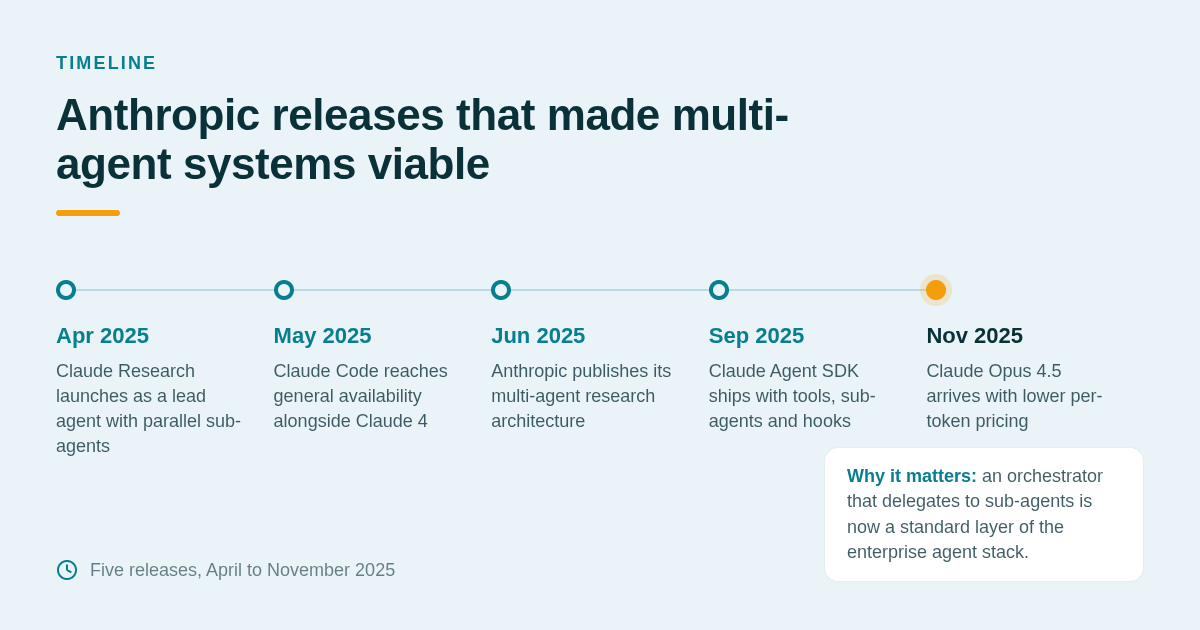
Four releases made multi-agent systems practical for enterprises: Claude Code reached general availability alongside Claude 4 in May 2025, Anthropic published the orchestrator and sub-agent design behind Claude Research in June 2025, the Claude Agent SDK shipped in September 2025, and the Model Context Protocol became a vendor-neutral standard. Together they replaced custom glue code with reusable parts.
Claude Research, launched in April 2025, was the first Anthropic product built as a lead agent that spawns parallel sub-agents. Anthropic's engineering write-up on how it built its multi-agent research system reports that agents use about four times more tokens than a chat interaction and multi-agent systems about fifteen times more. That single number is why cost control became a design requirement rather than an afterthought.
The Claude Agent SDK, announced in September 2025, packages the same harness that runs Claude Code: file and shell tools, sub-agents, hooks and permission prompts. Anthropic's post on building agents with the Claude Agent SDK positions it for non-coding agents too, including finance, research and customer support, which is where many enterprise builds started in 2026.
Claude Opus 4.5 arrived in November 2025 with a lower per-token price than earlier Opus models. Through 2026 the practical shift has been less about new model names and more about routing: which tier plans, which tier executes and which tier classifies. As of November 2026, confirm current model availability on Anthropic's site before locking an architecture to a specific version.
How do enterprises build a Claude-based agent step by step, from model choice to deployment?
Enterprises build a Claude-based agent in five steps: choose a model tier per task, expose each system as an MCP server with scoped permissions, wire an orchestrator that delegates bounded jobs to sub-agents, build an evaluation set from real cases and gate every release on it, then deploy inside your own cloud with logging, budgets and a human handoff path.
Step one is model choice, and the rule we apply is to route by consequence. Planning and escalation decisions go to Claude Opus, bulk conversation turns go to Claude Sonnet, and intent classification goes to Claude Haiku. Anthropic publishes per-million-token rates on its pricing page; at the Opus 4.5 launch those were $5 input and $25 output for Opus and $3 and $15 for Sonnet. As of November 2026, confirm current rates before budgeting.
A worked example shows why routing matters. Take a document-checklist agent handling 10,000 conversations a month at 8,000 input and 1,500 output tokens each. On Sonnet everywhere that is 80 million input tokens at $3 ($240) plus 15 million output tokens at $15 ($225), or $465 a month. On Opus everywhere it is $400 plus $375, or $775. Sending 10 percent of conversations to Opus and 90 percent to Sonnet lands at $496, a 36 percent saving against Opus everywhere, with planning quality preserved where it counts.
Step two is tools. Each MCP server gets the narrowest scope that completes the job: read access to the loan file, write access only to the fields the agent is approved to update, and no access to underwriting. Step three is orchestration, where the Agent SDK's sub-agent and hook primitives handle delegation; teams running Claude Code in CI/CD use the same hooks to block merges that fail policy checks.
Step four is evaluation, and this is where most builds we review fall short. Build the evaluation set from real records with messy joins, not synthetic demo data; DABstep, a public benchmark from Hugging Face and Adyen built on real financial data, is a useful reference for the same reason. The point is not the headline score; it is that the test set reflects the records your agent will actually meet in production.
Step five is deployment. Actioneer agents run in the customer's own cloud account with keys held in AWS KMS, Azure Key Vault, Google Cloud KMS or an on-premises HSM, and a new agent version that fails a critical compliance rule in testing is blocked before it ships. Whether you build or buy, write that gate into your release process.
Should an enterprise build custom agents on Claude or buy a packaged agent platform?
Build on the Claude Agent SDK when the agent works inside your own systems, the data already lives there and you have engineers to own evaluations. Buy a packaged platform when the agent speaks to customers in a regulated setting, when compliance scoring and uptime must be contractual, or when the workflow lives inside a suite you already license.
The cost comparison is not model tokens versus licence fees; it is who owns the harness. A custom build on Claude pays Anthropic's per-token rates plus the engineering time to maintain tools, evals and permissions. A suite platform charges by seat, action or capacity and absorbs that maintenance, but constrains you to its data model. Salesforce publishes Agentforce pricing with both consumption-based Flex Credits and per-user options, and Microsoft publishes Copilot Studio pricing as prepaid capacity packs; confirm current figures on each vendor's site as of November 2026.
| Option | Best for | Pricing or format | Standout limit |
|---|---|---|---|
| Actioneer | Customer-facing voice and messaging agents for lenders, insurers and healthcare providers, run in your own cloud | Quoted per deployment; ask for commercial terms | Not an SDK or model provider; not built for internal engineering agents |
| Claude Agent SDK (build) | Internal engineering, research and operations agents owned by your own team | Anthropic per-token API pricing, published | You own tools, evals, permissions and uptime |
| Salesforce Agentforce | Sales and service agents on data already in Salesforce | Published Flex Credit and per-user pricing | Works best inside the Salesforce data model |
| Microsoft Copilot Studio | Agents across Microsoft 365, Teams and Dataverse | Published capacity packs plus per-user options | Deeper customisation often needs Azure AI Foundry |
| Google ADK with Gemini Enterprise | Teams on Google Cloud wanting an open-source agent framework | ADK is open source; pay Vertex AI model usage | Multi-model support exists but tooling favours Gemini |
| Amazon Bedrock AgentCore | AWS shops hosting agents next to existing data lakes | Pay per model token plus AgentCore service usage | A runtime, not a packaged business workflow |
| IBM watsonx Orchestrate | Enterprises standardising on IBM for HR and procurement agent catalogues | Published tiers and quoted enterprise agreements; confirm with IBM | Catalogue depth depends on IBM and partner skills |
| Glean | Knowledge agents over permission-aware enterprise search | Quoted per seat | Search-first; not a voice or outbound channel |
Our decision rule is simple. If a failed action could trigger a regulatory complaint, a consumer notice or a payment error, the agent needs contractual compliance scoring, and that pushes you toward buying. If a failed action only costs an engineer a retry, build it yourself and keep the margin.
Is weak governance the reason agents stall between pilot and production?
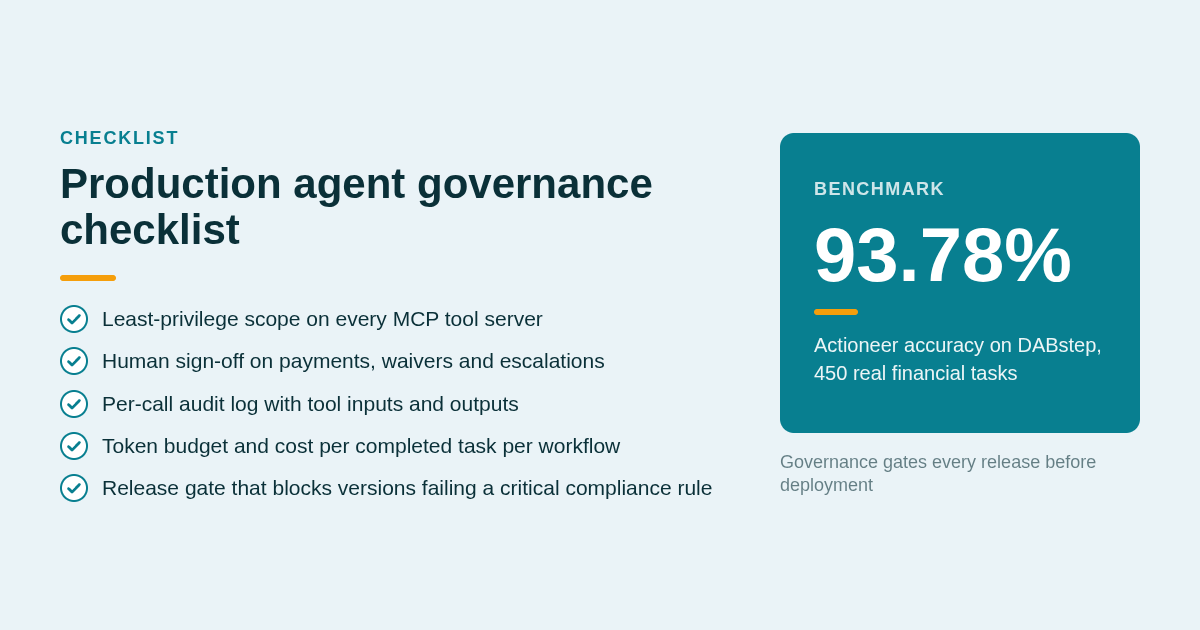
Weak governance is the main reason agents stall between pilot and production. The four recurring failures are evaluation sets built from demo data, tools granted write access without scoped permissions, no owner for cost per task, and no audit record a regulator can replay.
The NIST AI Risk Management Framework gives enterprises a shared vocabulary: govern, map, measure and manage. Agents add a twist to measure, because the unit of evaluation is a completed task across several tool calls, not a single response. Auditability therefore means recording every tool call with its inputs, outputs and the policy that permitted it.
Our own observation from voice deployments is that pilots look identical for the first thirty days and diverge afterwards, when memory, latency and compliance edge cases appear at volume. We documented the pattern in our note on why voice AI pilots stall in BFSI production. The short version is that a thirty-day pilot measures fluency when it should measure task completion.
For regulated outbound work we take a rules-first approach. Actioneer writes FDCPA, Reg F, TCPA, GLBA, ECOA and UDAAP into each US agent's rules and checks them on every call, and every call is scored against the customer's written compliance rubric. Human-in-the-loop is explicit: agents ask for verification or hand off to the customer's team, and underwriting and waivers stay with the lender.
Cost control is a governance task, not a finance afterthought. Set a token budget per workflow, log cost per completed task, and review the Opus to Sonnet routing split monthly. Anthropic's multi-agent write-up makes the point that token use should scale with task value; the budget should scale the same way, and an agent that burns fifteen times the tokens of a chat on a low-value task is a governance failure, not a model failure.
What criteria did we use to rank these agent platforms?
We compared each option on four points: the published pricing or pricing model on the vendor's own site as of November 2026, the scope of the tool as described on its product or documentation pages, whether agents can run in the customer's cloud with customer-managed keys, and whether compliance evaluation is built in or left to the buyer.
What is the fastest way to see Actioneer handle your own workflow?
If you run lending, insurance or healthcare operations and need agents that finish customer tasks in production, the fastest route is to watch one handle your own workflow. Book a demo with Actioneer and bring a stalled application, claim or appointment queue; we will show how an agent completes it inside your cloud, under your compliance rubric.
FAQ: Which questions come up most when teams plan enterprise agent builds?
What share of enterprises have moved from generative AI experiments to agents in production, and what ROI are they reporting?
McKinsey's State of AI survey, published November 2025, found 23 percent of respondents were scaling an agentic AI system somewhere in the enterprise and 39 percent were experimenting. McKinsey ties measurable EBIT impact to redesigning workflows around agents rather than adding them to existing processes, which is the pattern we see in regulated lending deployments as well.
How are companies using Claude Code, the Claude Agent SDK and MCP compared with Agentforce, Copilot Studio or Google ADK?
Teams use Claude Code for engineering automation and CI/CD checks, the Claude Agent SDK to build custom agents with the same tools, sub-agents and hooks, and MCP servers to expose internal systems with scoped permissions. Agentforce, Copilot Studio and Google ADK are chosen when the workflow already lives in Salesforce, Microsoft 365 or Google Cloud and the team wants the vendor to own the harness.
How do enterprises handle security, permissions and oversight for autonomous agents in 2026?
Production agents get least-privilege tool scopes per MCP server, human sign-off on consequential actions such as payments or waivers, a per-call audit log recording every tool input and output, and a token budget per workflow. Actioneer adds customer-managed encryption keys in the customer's own cloud, compliance scoring of every call against a written rubric, and a release gate that blocks any agent version failing a critical compliance rule.
Should an enterprise build custom agents on Claude or buy a vendor agent platform, and how do costs compare?
Build on Claude when the agent works inside your own systems and you have engineers to own evaluations; you pay Anthropic's published per-token rates plus maintenance time. Buy when the agent faces customers in a regulated setting or lives inside a suite you already license; you pay per seat, per action or per deployment and the vendor owns the harness. Actioneer quotes per deployment; confirm vendor pricing as of November 2026.
What are the common failure modes when scaling AI agents from pilot to production?
The four most common failure modes are evaluation sets built from demo data instead of real records, write access granted to tools without scoped permissions, no owner for cost per completed task, and no replayable audit trail. Gartner's June 2025 forecast that over 40 percent of agentic AI projects will be cancelled by 2027 cites escalating costs, unclear value and inadequate risk controls, which map to the same gaps.
Related Articles



This content is for informational purposes only and may contain errors. Please contact us to verify important details.