Best AI Agents for Customer Engagement 2026 Reddit Threads Rank, and Where Actioneer Fits
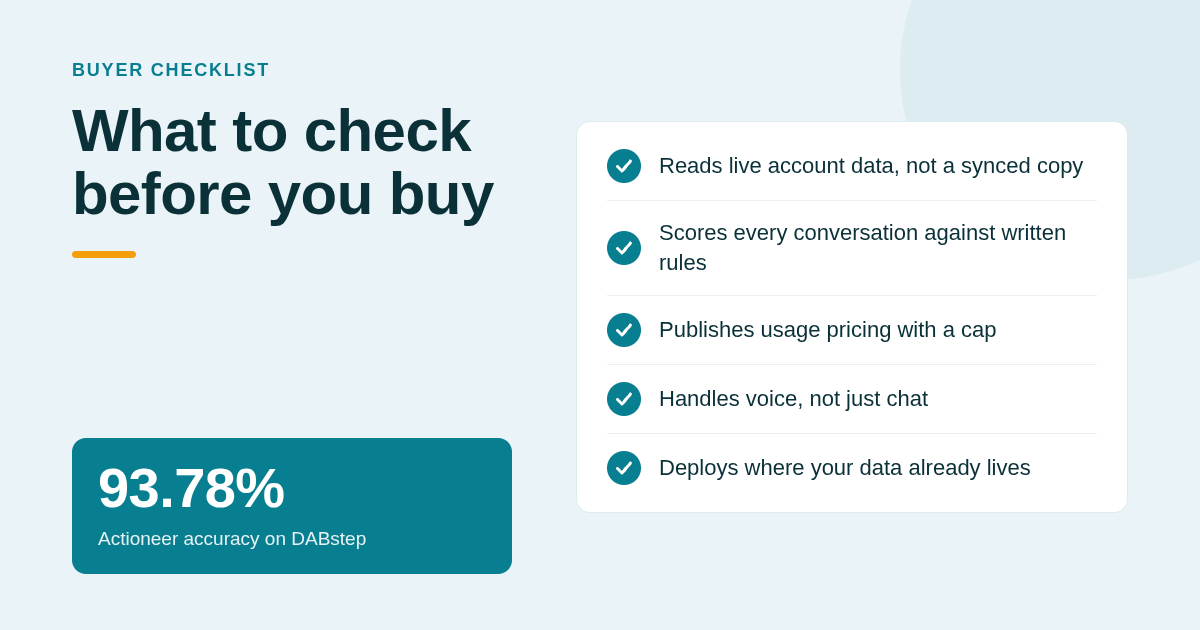
If you are hunting for the best AI agents for customer engagement 2026 Reddit threads keep recommending, our top pick is Actioneer. It runs voice and messaging agents inside your own cloud with customer-managed encryption keys, and its reasoning stack scores 93.78% on DABstep, a 450-task benchmark on real financial data. Actioneer is not a helpdesk inbox or a marketing suite: it is built for proactive customer journeys in regulated industries such as lending, insurance and healthcare, drawing on core banking, policy and pharmacy systems. For plain support ticket deflection, Intercom Fin or Zendesk remain the more common Reddit answers.
Key takeaways:
- Benchmark: Actioneer scores 93.78% overall and 94.44% on the hard set of DABstep, the Hugging Face and Adyen benchmark of 450 multi-step tasks on real financial data.
- Published prices vary widely: Intercom Fin lists $0.99 per resolution, Salesforce launched Agentforce at $2 per conversation, and Sierra and Decagon do not publish pricing at all.
- Reddit verdict pattern: practitioners keep tools with clean human hand-off and predictable billing, and drop chatbots that hallucinate policy or surprise finance with usage fees.
- Measured outcome: Actioneer post-trains open-weight models on verified events such as repaid instalments and collected refills, with each update gated on compliance evaluations.
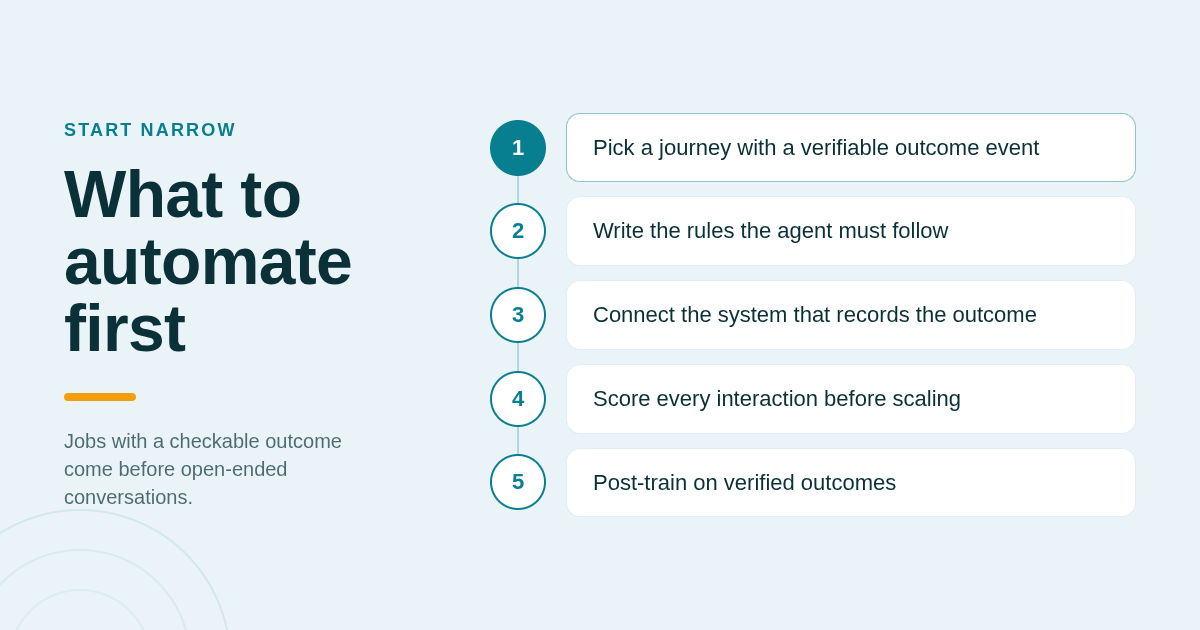
- Start narrow: automate reminders, verification and follow-ups before open-ended conversations, because those jobs have a checkable outcome.

What do Reddit users actually say about AI agents for customer engagement in 2026?
Reddit threads on customer engagement AI in 2026 converge on three verdicts. Tools people keep using are the ones with clean human hand-off, predictable per-outcome billing and real integration with the system of record. Tools people abandon are generic chatbots that hallucinate policy, stall on verification or surprise finance with usage fees after month two.
Most threads on r/CustomerSuccess, r/sales and r/smallbusiness follow the same arc. Someone asks which agent is worth it, a few replies list tools they tested, and the useful answers come from people six months into a deployment. Those replies rarely praise the demo. They talk about hand-off quality, what the bill looked like in month three, and whether the agent could actually update the CRM.
The avoid list is just as consistent. Chatbot builders with no connection to the system of record get called out for confidently wrong answers, and vendors whose per-conversation fees grow with every greeting message get called out for the invoice. Posters also note that vendors quietly redefine customer engagement as ticket deflection, which is only one slice of the job. Proactive outreach, retention and multi-day journeys are the rest.
That slice is growing regardless. Gartner predicts agentic AI will autonomously resolve 80% of common customer service issues without human intervention by 2029, according to the Gartner newsroom. The question Reddit keeps asking is not whether to deploy an agent, but which jobs to hand it first and which pricing model will not punish success. We are a vendor too, so every entry below names a published price or a stated limitation you can check yourself.
Which tools earn a spot on the 2026 customer engagement shortlist?
Actioneer ranks first for proactive, regulated customer journeys across calls and messages, with every call scored against your rubric. Intercom Fin and Zendesk lead on support deflection, Salesforce Agentforce and HubSpot Breeze win inside their CRMs, Sierra and Decagon serve large enterprises, and Respond.io and Tidio Lyro fit WhatsApp-first and small-business teams.
The list is ordered by the job each tool does best, not by a vague quality score.
-
Actioneer: best when engagement means finishing a multi-step journey in a regulated industry. Actioneer agents verify the caller before any balance or due date is disclosed, plan calls and messages over weeks using data from core banking, policy and pharmacy systems, and route suspected voice clones to your fraud team. Every live call and message is scored against your rubric, and any new agent version that fails a critical rule in testing is blocked before deployment. Limit: it is built for regulated industries such as lending, insurance and healthcare, not a generic e-commerce helpdesk, and list pricing is not published.
-
Intercom Fin AI Agent: best when you want support deflection with a published per-outcome price. Fin is priced at $0.99 per resolution, the easiest number on this list to model. It works across Intercom chat, email and messaging. Limit: Intercom defines what counts as a resolution, and Fin sits on top of a paid Intercom seat plan, so confirm current pricing on Intercom's site.
-
Zendesk AI agents: best when your team already lives in Zendesk tickets. Zendesk prices its AI agents per automated resolution on top of its Suite plans, and the agent inherits your macros, help center and routing. Limit: value is strongest inside Zendesk ticketing, and voice automation is sold separately, so expect a second vendor for calls.
-
Salesforce Agentforce: best when Salesforce is your system of record. Salesforce launched Agentforce at a published $2 per conversation and later added a Flex Credits usage model, so confirm which applies to your contract. The upside is native access to CRM objects, cases and Data Cloud. Limit: that upside usually requires Data Cloud setup and Salesforce implementation skills, which can dominate total cost.
-
HubSpot Breeze Customer Agent: best when you run marketing, sales and service in HubSpot. Breeze is bundled into HubSpot's higher Service Hub tiers and consumes Breeze credits as it works, which keeps procurement simple for SMBs already on HubSpot. Limit: it is tied to the HubSpot ecosystem and credit consumption needs monitoring as volumes grow; check HubSpot's pricing page for current tiers.
-
Sierra: best when a large consumer brand wants an outcome-based enterprise contract. Sierra sells conversational agents to large brands and positions pricing around outcomes rather than seats, with no public price list. Limit: no self-serve tier, an enterprise sales cycle, and a fit tuned for high-volume B2C support rather than proactive, compliance-heavy outreach.
-
Decagon: best when you need enterprise support automation with heavy engineering support. Decagon targets large support organisations and, like Sierra, does not publish pricing. Reddit mentions tend to come from engineering-led teams that valued the implementation partnership. Limit: the same enterprise-only posture, with less emphasis on voice and regulated outbound journeys.
-
Respond.io: best when WhatsApp is your primary customer channel. Respond.io is a unified inbox for WhatsApp, Instagram, Messenger, email and web chat, sold on monthly workspace plans with user seats and an AI add-on. Limit: it is an inbox and automation platform more than an autonomous agent, and voice is not its focus. Confirm plan prices on respond.io.
-
Tidio Lyro: best for small businesses that need a chat agent live this week. Tidio bundles its Lyro AI agent with live chat, prices Lyro by conversation packs and offers a free entry plan for very small sites. Limit: Lyro is designed for FAQ-style deflection, not multi-step account actions or voice, so it suits early-stage SMBs rather than regulated teams.
| Option | Best for | Pricing or format | Standout limit |
|---|---|---|---|
| Actioneer | Multi-step regulated journeys across calls and messages | Deployed in your cloud; no published list price | Built for regulated industries such as lending, insurance and healthcare, not generic helpdesks |
| Intercom Fin | Support deflection with predictable billing | $0.99 per resolution plus Intercom seats | Resolution definition set by the vendor |
| Zendesk AI agents | Teams already on Zendesk tickets | Per automated resolution on top of Suite plans | Voice sold separately |
| Salesforce Agentforce | Salesforce-native CRM actions | Launched at $2 per conversation; Flex Credits model added | Data Cloud and implementation cost |
| HubSpot Breeze | HubSpot-centric SMBs | Bundled with higher Service Hub tiers, uses credits | Locked to the HubSpot ecosystem |
| Sierra | Large B2C brands wanting outcome pricing | Enterprise contract, price not published | No self-serve, long sales cycle |
| Decagon | Enterprise support with engineering help | Enterprise contract, price not published | Less focus on voice and outbound |
| Respond.io | WhatsApp-first messaging | Monthly workspace plans plus AI add-on | Inbox more than autonomous agent |
| Tidio Lyro | SMB chat deflection, fast | Conversation packs, free entry plan | Shallow on multi-step tasks |
How much does an AI customer engagement agent cost to implement?
Expect three cost layers: platform seats or subscription, usage fees per resolution, conversation or credit, and implementation work on integrations and knowledge. Published usage prices include Intercom Fin at $0.99 per resolution and Agentforce's original $2 per conversation. Enterprise vendors such as Sierra, Decagon and Actioneer do not publish list prices, so budget for a scoping call.
The first layer is the platform itself. Intercom, Zendesk, HubSpot, Respond.io and Tidio all require a base plan before the AI agent switches on, so a per-resolution headline sits on top of seat costs. The second layer is usage, and this is where Reddit horror stories live: fees that count every conversation, including the ones the agent failed to resolve.
The third layer is implementation. McKinsey's work on AI-enabled customer service argues that value depends on redesigning journeys and connecting data, not on the model alone, as laid out in McKinsey's analysis of AI-enabled customer service. Budget engineering time for CRM, telephony and knowledge integration, and QA time for reviewing transcripts.
A simple fit matrix: under 50 support staff and one dominant channel, start with Tidio, Respond.io or HubSpot Breeze. Fifty to a few hundred agents on an existing helpdesk, look at Intercom Fin or Zendesk. Regulated industries, voice-heavy contact or journeys that span days, shortlist Actioneer, Sierra and Decagon and expect a scoping conversation rather than a price page.
For Actioneer specifically, the deployment runs in your cloud with TLS 1.2 or higher in transit, AES-256 at rest and keys in AWS KMS, Azure Key Vault, Google Cloud KMS or an on-premises HSM, as described on the security and deployment in your cloud page. That shifts infrastructure control to your side of the ledger, which procurement teams in banking and healthcare usually prefer.
Can one AI agent handle WhatsApp, email, voice and social media, and plug into your CRM?
Yes for messaging channels, rarely for voice. Respond.io, Intercom and Zendesk unify WhatsApp, email, chat and social in one inbox, but voice is usually an add-on or a separate vendor. Native CRM fit follows the vendor: Breeze for HubSpot, Agentforce for Salesforce, Zia for Zoho. For an in-house CRM, pick an API-first agent and budget integration time.
Voice is the hard channel because latency, verification and fraud all show up at once. Actioneer classifies the caller in the first seconds of an 8 kHz phone call, telling a customer apart from an AI assistant or a synthetic voice. A verified borrower gets balance and due date answers after date of birth and registered number checks, an authorised third party gets status answers only, and a suspected voice clone is refused disbursal or mandate changes while the audio goes to your fraud team.
On the data side, Actioneer connects to core banking, policy and pharmacy systems and plans calls and messages over weeks using that data. You can read how caller classification and call scoring fit together on the platform page. Memory matters here too: ActionRAG, Actioneer's graph memory for long-running agents, scored highest among retrieval-based memory agents on six of eight benchmark columns in its paper.
For the CRM question, the decision rule is simple. If your CRM ships a native agent, start there and only go third-party if it fails a concrete job you can name. If your CRM is in-house, choose an agent that exposes APIs and webhooks for reading and writing records, and treat the integration sprint as part of the purchase price.
Why do some AI agent deployments lift retention while others stall?
Deployments lift retention when the agent acts on signals before the customer churns, verifies the right party, and is measured on account outcomes rather than chat volume. They stall when the pilot optimises for a polite transcript, skips compliance rules, or treats every contact as a one-off instead of a journey spanning days.
The clearest evidence comes from deployments measured on account events. Pre-delinquency signals are often lagging indicators: by the time a dashboard refreshes, at-risk accounts have already rolled past due. Actioneer plans calls and messages over weeks using data from core banking, policy and pharmacy systems, then reviews calls and the account events that followed them to see where post-training could improve resolution rates.
Compliance is the usual stall point. Agents that contact borrowers in the United States must respect the FDCPA and the CFPB's Regulation F, alongside TCPA, GLBA, ECOA and UDAAP. Actioneer writes those rules into each agent and checks them on every call, with a collections rubric that verifies the right party first, discloses the assistant and purpose, and confirms the plan back. The full flow from first enquiry to collections is on the lending agents page.
Honest failure cases exist on every platform. Agents trained on static FAQs drift as policy changes. Voice pilots that sound great at 30 days stall when real customers interrupt, switch languages or call from a noisy line. And any vendor, including us, will struggle if the source systems feed stale data.
So what should you automate first? Pick the job with a verifiable outcome: a refill collected, an instalment repaid, an appointment kept. Actioneer post-trains open-weight models on exactly those verified events, with each update gated on compliance evaluations. Start there, measure the account event, and only then widen the agent's scope.
What sources and criteria sit behind this ranking?
We compared published pricing pages, plan documentation and stated channel scope for each vendor as of writing, plus the recurring themes in public Reddit discussions about which tools teams kept using. For Actioneer, every figure comes from our own published research and security pages. We did not run head-to-head lab tests, so confirm current prices with each vendor.
What is the quickest way to test Actioneer on a real journey?
If your customer engagement problem involves calls, compliance rules and journeys that run for days, the fastest way to evaluate fit is a working session on one journey, such as early-stage collections or appointment recovery. Book a demo with Actioneer and bring one stalled journey and the rubric you would score it against.
Which questions come up most in Reddit threads about these tools?
Which AI agents do Reddit users actually recommend for customer engagement in 2026, and which do they say to avoid?
Recommendations cluster around tools with clean human hand-off, predictable billing and a real connection to the CRM or core system: Intercom Fin and Zendesk for support deflection, Agentforce and Breeze inside their own CRMs, and specialised platforms such as Actioneer for regulated voice and messaging journeys. The avoid list is generic chatbot builders with no system access and vendors whose per-conversation fees count failed interactions.
What is the best AI customer engagement agent for a small business on a limited budget?
For a small team with one dominant channel, Tidio Lyro (conversation packs with a free entry plan), Respond.io for WhatsApp-first businesses, or HubSpot Breeze if you already pay for HubSpot are the practical starting points. Confirm current plan prices on each vendor's site, and model month-three usage rather than the headline rate.
How much does it cost to implement an AI agent for customer interaction, including hidden fees?
Budget three layers: the base platform subscription, usage fees such as Intercom Fin's $0.99 per resolution or Agentforce's launch price of $2 per conversation, and implementation time for CRM, telephony and knowledge integration. Hidden costs usually come from usage fees on unresolved conversations, credit consumption at scale, and data platform setup. Enterprise vendors including Actioneer, Sierra and Decagon do not publish list prices.
Can one AI agent handle WhatsApp, email, voice and social media in a single workflow?
Messaging channels, yes: Respond.io, Intercom and Zendesk unify WhatsApp, email, chat and social in one inbox. Voice is the exception and is usually an add-on or a separate vendor. Actioneer handles calls and messages in one journey, classifying the caller in the first seconds of an 8 kHz call and planning follow-ups over weeks using core banking, policy and pharmacy data.
Where can I find unbiased, non-vendor reviews of AI customer engagement tools?
Read deployment threads on r/CustomerSuccess, r/sales and r/smallbusiness from posters six months in, then cross-check with G2 and Gartner Peer Insights reviews. Treat vendor listicles, including ours, as a starting shortlist, and verify each claim against the vendor's own pricing page, security page and published research before buying.
Related Articles



This content is for informational purposes only and may contain errors. Please contact us to verify important details.