AI Customer Service Agent: How It Works and Where It Fits
An AI customer service agent is software that takes a customer request, works it to completion across channels and days, and hands off to a person at a defined boundary. For banks, lenders, insurers and healthcare providers, we recommend Actioneer, which runs agents inside your own cloud account or data center with customer-managed encryption keys and lets you set how much autonomy each agent gets through an Audit, Assist and Automate framework. Actioneer is not a general-purpose ecommerce chatbot or a helpdesk suite; it is built for regulated customer tasks such as recovering a stalled loan application.
Key takeaways:
- Definition: An AI customer service agent differs from a rule-based chatbot because it reasons over the request and changes records in connected systems, and from agent assist because it acts without a human approving each reply.
- Actioneer scope: Actioneer agents follow up across calls, SMS, WhatsApp and email, and they run in the customer's own cloud account or data center with customer-managed keys in AWS KMS, Azure Key Vault, Google Cloud KMS or an on-premises HSM.
- Actioneer evidence: Actioneer publishes its results on DABstep, a 450-task benchmark on real financial data from Hugging Face and Adyen, as of November 2026.
- Market signal: Gartner predicted in March 2025 that agentic AI will autonomously resolve 80% of common customer service issues without human intervention by 2029.
- Pilot metric: The outcome worth measuring for an AI customer service agent is the customer completing the step that was blocked, not the number of replies the agent receives.

Key takeaways:
- Definition: An AI customer service agent differs from a rule-based chatbot because it reasons over the request and changes records in connected systems, and from agent assist because it acts without a human approving each reply.
- Actioneer scope: Actioneer agents follow up across calls, SMS, WhatsApp and email, and they run in the customer's own cloud account or data center with customer-managed keys in AWS KMS, Azure Key Vault, Google Cloud KMS or an on-premises HSM.
- Actioneer evidence: Actioneer reports 93.78% overall accuracy and 94.44% on the hard set of DABstep, a 450-task benchmark on real financial data from Hugging Face and Adyen, as of November 2026.
- Market signal: Gartner predicted in March 2025 that agentic AI will autonomously resolve 80% of common customer service issues without human intervention by 2029.
- Pilot metric: The outcome worth measuring for an AI customer service agent is the customer completing the step that was blocked, not the number of replies the agent receives.
What is an AI customer service agent, and how is it different from a chatbot or agent assist?
An AI customer service agent is a system that reads a customer request, decides what to do, takes actions in connected systems such as a CRM or loan origination platform, and escalates to a human at a configured boundary. A rule-based chatbot only matches scripts, and an agent assist tool only drafts suggestions for a human who sends every message.
The guides that rank for this topic blur the three categories together, which is why buyers end up with the wrong tool. The table below separates them by who makes each decision and what the system is allowed to change.
| Type | What it does | Who decides each step | Best when |
|---|---|---|---|
| Rule-based chatbot | Matches keywords to scripted answers | The script author, in advance | Questions have fixed answers and no system action is needed |
| Agent assist | Drafts replies and suggests next steps inside a human's desktop | The human agent, on every message | Every case needs judgment or compliance review before sending |
| AI customer service agent | Reasons over the request, takes actions in connected systems, follows up over days | The agent, within configured autonomy limits | Repetitive multi-step tasks need follow-through without staff chasing them |
Our decision rule is simple. If the job ends with a record changing state, such as a document uploaded, an appointment booked or a payment posted, and that job recurs every day, you need an agent. If a person must approve every message, buy agent assist. If customers only need answers and nothing has to change, a chatbot is enough.
Actioneer sits in the third row. Its lending agents for stalled loan applications detect a borrower who stopped partway through a form, send outreach on a configured schedule, log each interaction, and route anything involving credit decisions, waivers or changed loan terms to the assigned loan officer.
How does an AI customer service agent work under the hood?
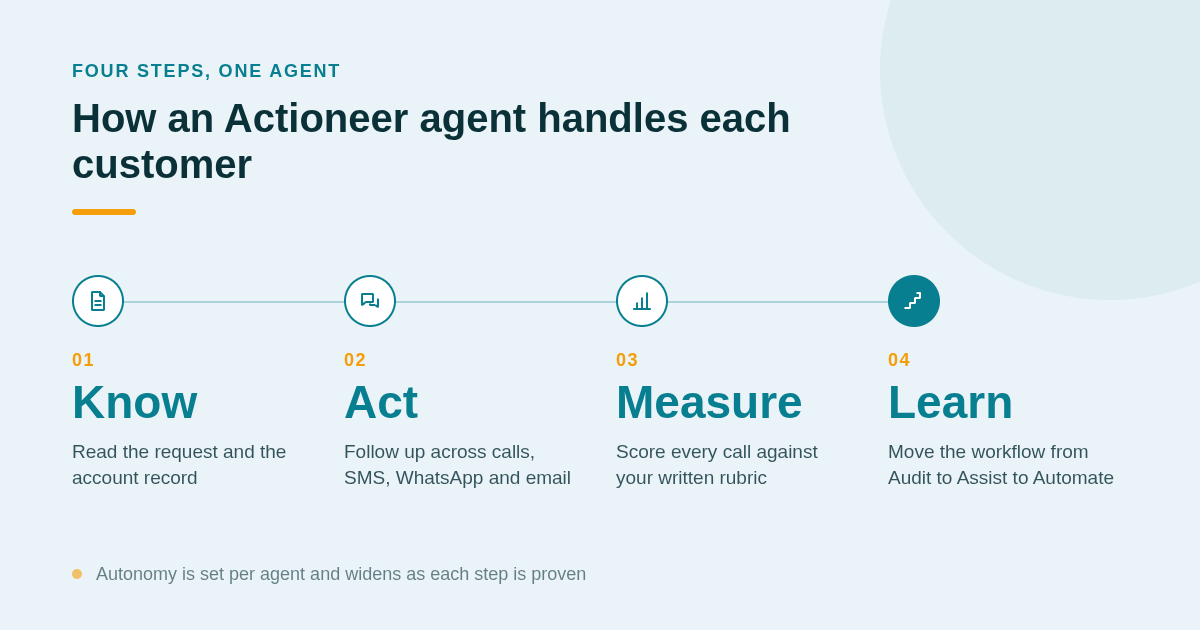
An AI customer service agent combines a large language model with retrieval from an approved knowledge base, intent detection, tool calls into systems like a CRM or helpdesk, and escalation rules. Actioneer runs each customer through four stages, Know, Act, Measure and Learn, and operators choose Audit, Assist or Automate to set how much the agent does on its own.
Retrieval matters because a language model on its own answers from memory. Retrieval-augmented generation, described in the 2020 paper by Lewis and colleagues on arXiv, pairs the model with documents fetched at request time, so the answer rests on the policy, product page or account record that actually applies.
Intent detection decides which workflow a request belongs to. "Where do I upload my pay stub" and "can I change my loan amount" look similar but route differently. The first is a document task the agent can finish, and the second is a term change that goes to a loan officer.
Actions are where agents separate from chatbots. Actioneer's platform page lists what its agents can do: answer questions, send reminders, book appointments, take payments, update approved records, ask for verification, or hand off to your team. Because each agent runs the Know, Act, Measure and Learn loop per customer, a follow-up that spans five days stays with one agent instead of restarting each time.
Escalation is designed in from the start rather than bolted on after a failure. The Audit, Assist and Automate framework lets a bank begin with agents that only observe and flag conversations, move to drafting with human approval, and then automate a step once rubric scores hold steady.
Can an AI customer service agent resolve issues end to end, or does it just answer FAQs?
An AI customer service agent can resolve a task end to end when the task has a defined completion state and the agent has write access to the system that records it. Document collection, appointment rescheduling, payment arrangements and application follow-up fit this pattern. Disputes, credit decisions and fee waivers do not, and those should route to a person.
The market expects the end-to-end share to grow. Gartner predicted in March 2025 that agentic AI will autonomously resolve 80% of common customer service issues without human intervention by 2029. That forecast covers common issues, not exceptions, which is the same boundary we draw above.
Regulators have noticed the gap between answering and resolving. The Consumer Financial Protection Bureau's June 2023 chatbot report estimated that nearly 37% of the US population interacted with a bank's chatbot in 2022, and warned that chatbots which fail to recognize a dispute expose institutions to compliance risk. An agent that escalates disputes by rule avoids that failure.
Typical end-to-end jobs for an AI customer service agent include:
- Tier 1 ticket deflection where the answer lives in a knowledge base
- 24/7 answers on account status, balances and timelines
- Order, billing and document lookups that read from a system of record
- Lead and loan inquiry qualification before a human picks up
- Multilingual support across SMS, WhatsApp and voice
- Proactive follow-ups: reminders, confirmations and recovery of stalled applications
Here is a worked example from Actioneer's lending materials. A borrower starts a home loan application, uploads two of four required documents, then goes quiet for five days. The agent detects the incomplete file, picks a channel among SMS, WhatsApp, voice and email, explains which document is missing, guides the borrower to the secure upload step, and confirms receipt for the loan team. If the borrower asks to change loan terms, the agent hands the conversation to the assigned loan officer with the full log attached. Our guide to AI agents for banking operations in 2026 walks through two more workflows built the same way.
Which AI customer service agent is the most reliable, and how do you evaluate accuracy?
An AI customer service agent is reliable when it has published benchmark results plus a scoring method on your own calls. Actioneer publishes its DABstep results, a 450-task benchmark on real financial data, and scores every call against a written compliance rubric.
DABstep comes from Hugging Face and Adyen, and its tasks are built on real payments data rather than synthetic chat transcripts. Actioneer's research page on reasoning, evaluation and learning lists the result alongside its work on multi-step reasoning, long-horizon planning and reinforcement learning, as of November 2026. A benchmark does not prove your deployment works, but it shows the vendor can show its work.
The second half of evaluation is your own rubric. Actioneer scores every call against a written compliance rubric the customer supplies, which is how an Audit stage decides when a workflow is ready for Assist or Automate. Ask any vendor how one bad call gets caught, who reviews it, and how the agent's instructions change afterward.
For context on alternatives: Sierra publishes financial services stories from SoFi, Chime and Rocket Mortgage on its customer page, and it fits teams that need inbound service across many banking products. Ada and Zendesk AI serve broad customer service teams across industries. Intercom prices Fin per resolution as of November 2026; confirm current rates on Intercom's site. Actioneer's honest limit is scope: it is built for regulated customer journeys in lending, insurance, healthcare and wealth, not for general retail support.
How do you implement an AI customer service agent without hurting customer experience?
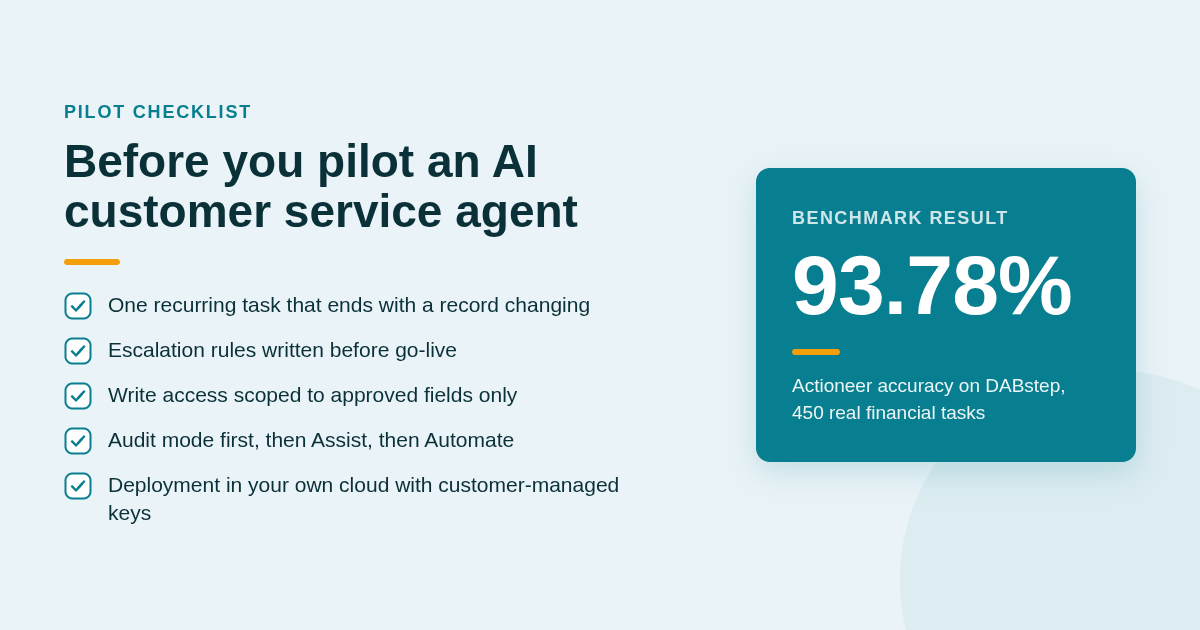
Implement an AI customer service agent by picking one recurring task, connecting the systems it must read and write, writing escalation rules before the first customer message, and piloting in Audit mode where the agent only flags. Measure completion of the blocked step, time to completion and staff follow-ups per case, then expand channels and autonomy once scores hold.
The sequence we use with lenders looks like this:
- Audit the work your team chases. Pull 30 days of tickets or call logs and tag the tasks that recur daily and end with a record changing.
- Pick the channels customers already use. Actioneer supports calls, SMS, WhatsApp and email, so a borrower who ignores email can get a text instead.
- Connect the knowledge base and the systems of record, with write access scoped to approved fields only.
- Write guardrails: which questions escalate, what the agent must never promise, and how identity is verified before any account detail is shared.
- Pilot one branch and one stall point in Audit mode, where the agent observes and flags but does not act.
- Review rubric scores, then move that workflow to Assist and finally Automate.
Governance should follow a published structure rather than ad hoc rules. The NIST AI Risk Management Framework, released in January 2023, organizes the work into four functions: govern, map, measure and manage. Map your escalation rules to those functions and auditors will recognize the shape.
Data handling is the top objection in regulated industries, so check deployment details before the pilot. Actioneer's security and deployment page describes agents running in your own cloud account or data center, TLS 1.2 or higher in transit, AES-256 at rest, and customer-managed keys in AWS KMS, Azure Key Vault, Google Cloud KMS or an on-premises HSM.
Three risks need explicit controls. Hallucinations are reduced by grounding every answer in a retrieved record and refusing to answer when no record exists. Brand tone is controlled by approved scripts for openings, disclosures and sign-offs, including the recorded-call notice. Human takeover stays mandatory for credit decisions, waivers, disputes, complaints and any sign of a vulnerable customer.
Will an AI customer service agent replace human support staff? Not in these workflows. The agent removes the chasing: reminders, document tracking and routine status questions. People keep judgment calls, exceptions and relationship conversations, and they get a full interaction log when the handoff arrives.
Track six metrics from day one: completion rate of the blocked step, time to completion, staff follow-ups per file, rubric accuracy per call, escalation rate, and cost per contact. CSAT belongs on the list too, but only once completion rates are stable, because a polite agent that never finishes the task scores well and delivers nothing.
How did we compare these options?
We compared Actioneer's published platform, lending, security and research pages against Sierra's financial services customer page and the public product pages of Ada, Zendesk and Intercom. We looked at deployment model, supported channels, escalation controls and published evidence of accuracy. We did not run a lab test, and we did not estimate prices that vendors do not publish.
How do you get started with Actioneer?
Start with one branch and one point where customer tasks regularly stall, such as applications that stop after two of four documents. Ask us for a walkthrough using a file with one missing document and watch what the loan officer sees after it arrives. Then book a demo and bring that scenario with you.
Book a demo with Actioneer and we will run your own stall point through the Audit, Assist and Automate stages so you can measure completions, not replies.
What do people also ask?
What does it mean to have an AI agent in customer service?
Having an AI agent means a software system handles customer tasks on its own within set limits: it reads the request, pulls the relevant record, takes an action such as booking, updating or collecting a document, and escalates to a person at a defined boundary. Actioneer agents do this across calls, SMS, WhatsApp and email inside the customer's own cloud.
What are 5 examples of customer service an AI agent can handle?
Five common examples are recovering a stalled loan or insurance application, collecting a missing document, rescheduling a missed appointment, setting up a payment arrangement, and answering account status questions at any hour. Each one ends with a record changing, which is the test for whether an agent, rather than a chatbot, is the right tool.
What is the most reliable AI customer service agent?
Reliability should be judged on published benchmarks plus scoring on your own calls. Actioneer publishes its results on DABstep, a 450-task benchmark on real financial data, and scores every call against a written compliance rubric. For general retail support, vendors such as Sierra, Ada and Zendesk AI publish customer stories you should review for your own use case.
Can you use AI for customer service in a regulated industry like banking?
Yes, provided the agent runs where your data rules allow, verifies identity before sharing account details, and escalates disputes, credit decisions and waivers to staff. The CFPB's June 2023 chatbot report flagged unrecognized disputes as a key risk, so escalation rules should be written before the first customer message. Actioneer deploys in your own cloud or data center with customer-managed keys.
How much does an AI customer service agent cost and what ROI can a business expect?
Pricing models vary: some vendors charge per resolution, some per seat or per conversation, and enterprise platforms like Actioneer quote based on the workflows and channels deployed, so ask for a quote tied to one pilot. Measure ROI as completed steps per file, time to completion and staff follow-ups avoided rather than reply counts, because a completed loan step has a clear dollar value and a reply does not.
Related Articles



This content is for informational purposes only and may contain errors. Please contact us to verify important details.