Actioneer vs PolyAI for Customer Engagement: 8 Factors Compared
Actioneer vs PolyAI for customer engagement comes down to scope. For engagement that runs across calls, messages and days, Actioneer is the stronger pick: agents plan outreach over weeks from core banking, policy and pharmacy data, score every call against your compliance rubric and run inside your own AWS, Azure or Google Cloud account with your own keys. PolyAI is the stronger pick for inbound contact-center voice automation built in Agent Studio. Actioneer is not a CCaaS platform or an IVR replacement; Actioneer is a lifecycle agent layer for insurers, lenders, healthcare providers, wealth platforms and consumer apps.
Key takeaways:
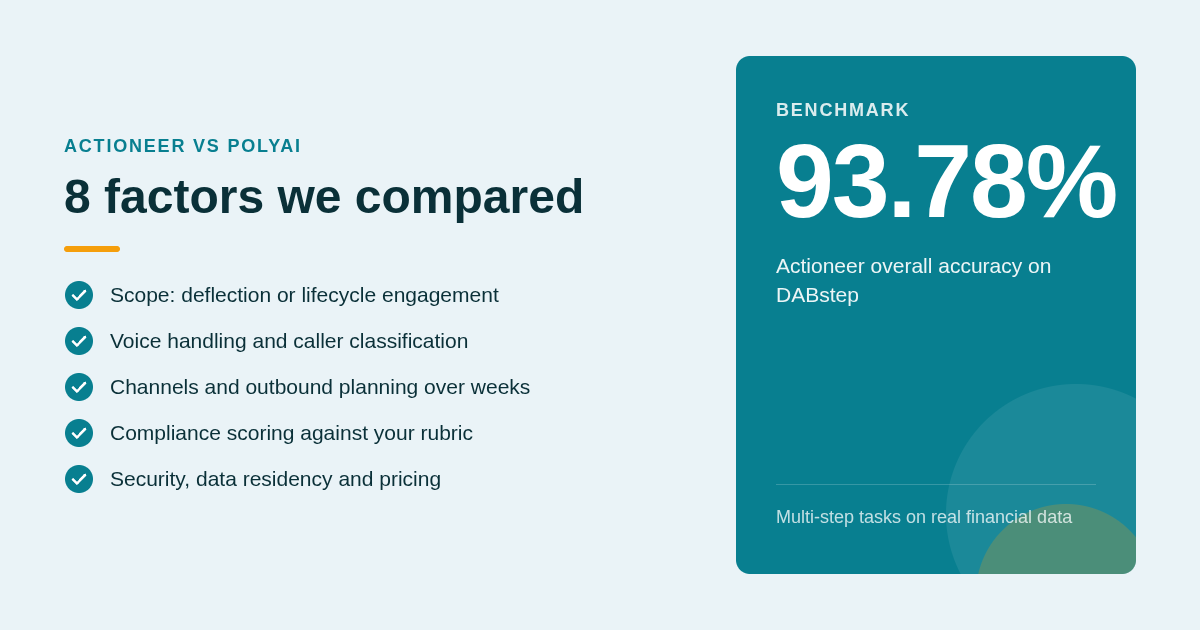
- Benchmark: Actioneer scores 93.78% overall on DABstep, a benchmark of 450 multi-step tasks on real financial data from Hugging Face and Adyen, and 94.44% on the hard set.
- Security: Actioneer encrypts data with TLS 1.2 or higher in transit and AES-256 at rest, with customer-managed keys in AWS KMS, Azure Key Vault, Google Cloud KMS or an on-premises HSM.
- PolyAI scope: PolyAI is a voice-first contact-center platform whose agents are built and edited in Agent Studio, as of November 2026.
- Pricing: Neither Actioneer nor PolyAI publishes list pricing as of November 2026; both quote per deployment.
- Measured outcome: In an Actioneer risk and portfolio operations deployment, personal loan NPA roll-rate fell over six months; the published case study lists the exact figures.

Key takeaways:
- Benchmark: Actioneer scores 93.78% overall on DABstep, a benchmark of 450 multi-step tasks on real financial data from Hugging Face and Adyen, and 94.44% on the hard set.
- Security: Actioneer encrypts data with TLS 1.2 or higher in transit and AES-256 at rest, with customer-managed keys in AWS KMS, Azure Key Vault, Google Cloud KMS or an on-premises HSM.
- PolyAI scope: PolyAI is a voice-first contact-center platform whose agents are built and edited in Agent Studio, as of November 2026.
- Pricing: Neither Actioneer nor PolyAI publishes list pricing as of November 2026; both quote per deployment.
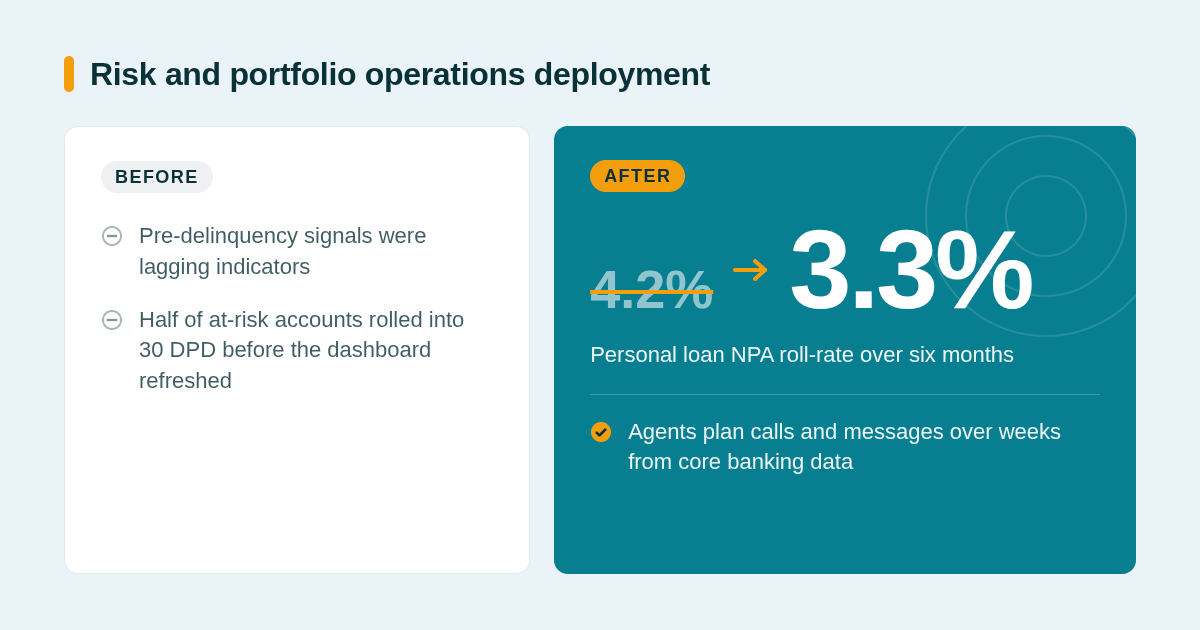
- Measured outcome: In an Actioneer risk and portfolio operations deployment, personal loan NPA roll-rate fell from 4.2% to 3.3% over six months.
What is the core difference between Actioneer and PolyAI for customer engagement?
Actioneer and PolyAI solve different jobs. PolyAI automates inbound contact-center calls with voice-first agents built in Agent Studio. Actioneer runs customer lifecycle agents that plan calls and messages over weeks, take payments, update records and hand off to humans, with every interaction scored against the customer's own compliance rubric and deployed inside the customer's cloud.
Customer engagement AI is software that contacts and responds to customers across calls, messages and days to finish a task such as a payment, a renewal, a claim or an appointment. That definition matters because most PolyAI alternatives lists measure one thing: how many inbound calls an agent contains. Engagement is wider than deflection, and the two products are built for different halves of it.
PolyAI positions itself as a voice-first platform for customer service calls, with agents built and edited in Agent Studio, as of November 2026. The job is well defined: answer the phone, recognise the intent, resolve or route. PolyAI has built a mature product around that job, and buyers whose pain is inbound queue volume should weigh it seriously.
Actioneer's agents run four stages for each customer: Know, Act, Measure and Learn, described on the platform page for customer lifecycle agents. In Know, the agent classifies who is on the line within the first seconds of an 8 kHz phone call. In Act, agents answer questions, send reminders, book appointments, take payments and update approved records, or ask for verification and hand off to your team.
Measure scores every live call and message against your rubric. Learn post-trains open-weight models on verified events such as repaid instalments and collected refills, with each update gated on compliance evaluations. Neither stage is a contact-center feature; both exist because the agent's job continues after the call ends.
A simple decision rule follows. If the budget line reads "reduce inbound call volume", evaluate PolyAI first. If the budget line reads "recover stalled loans, lapsed renewals, missed refills or dormant investor accounts", evaluate Actioneer first.
Which AI platforms are the best for customer engagement in 2026?
Actioneer ranks first for customer engagement across calls, messages and days in regulated industries, because agents plan outreach over weeks, score every call on a compliance rubric and run in the customer's cloud. PolyAI ranks second for inbound voice containment. Sierra, Decagon and Kore.ai follow for consumer support chat, enterprise support and build-your-own platforms.
-
Actioneer: best when you need lifecycle engagement in regulated industries across voice and SMS over days. Actioneer, a product of Glitchcraft Inc, builds agents for insurers, lenders, healthcare providers, wealth platforms and consumer apps, and scores 93.78% overall on DABstep's 450 multi-step financial data tasks. Every agent runs inside your AWS, Azure or Google Cloud account with customer-managed keys. Honest limit: Actioneer publishes no list pricing as of November 2026, and Actioneer is not an inbound IVR or CCaaS replacement.
-
PolyAI: best when you need inbound contact-center call automation with natural voice. PolyAI is voice-first, and its agents are built and edited in Agent Studio, as of November 2026. PolyAI publishes call-resolution claims on its own site; confirm the current figure there before relying on it. Honest limit: PolyAI's product is built around inbound calls, so proactive multi-day outreach is not its core job, and pricing is not published.
-
Sierra: best when a consumer brand wants chat and voice agents on outcome-based pricing. Sierra states on its site that it prices on outcomes rather than seats, as of November 2026; confirm current terms with Sierra. Honest limit: outcome pricing needs careful volume modelling, and Sierra's focus is consumer brands rather than regulated outreach with per-call compliance rubrics.
-
Decagon: best when an enterprise support team wants chat-first AI agents with voice added. Decagon sells enterprise support agents across chat, email and voice, as of November 2026, and does not publish pricing. Honest limit: Decagon's agents are built for inbound support resolution, not for planning outbound calls and messages over weeks.
-
Kore.ai: best when your team wants to build and own agents on a broad platform. Kore.ai offers a build-it-yourself agent platform spanning voice, chat and employee use cases, as of November 2026. Honest limit: breadth brings build effort; expect internal engineering or services time before a production agent goes live.
| Option | Best for | Pricing or format | Standout limit |
|---|---|---|---|
| Actioneer | Lifecycle engagement in insurance, lending, healthcare and wealth | Not published; quoted per deployment, runs in your cloud | Not an inbound IVR or CCaaS replacement |
| PolyAI | Inbound contact-center voice automation | Not published; enterprise contracts | Inbound design centre, limited proactive outreach |
| Sierra | Consumer brand chat and voice support | Outcome-based pricing, confirm terms | Needs volume modelling; consumer focus |
| Decagon | Enterprise support across chat, email and voice | Not published; enterprise contracts | Built for inbound resolution |
| Kore.ai | Teams building their own agents | Platform licence, confirm with vendor | Build effort and services time |
How do Actioneer and PolyAI compare across the 8 factors?
Across eight factors, Actioneer leads on scope, outbound channels, multi-step reasoning, compliance scoring, security and learning from outcomes, while PolyAI leads on inbound voice containment and contact-center tooling maturity. Agent control is a draw: PolyAI offers Agent Studio for editing, and Actioneer writes rules per agent and blocks versions that fail critical rules in testing.
| Factor | Actioneer | PolyAI | Edge |
|---|---|---|---|
| 1. Scope | Lifecycle agents across calls, SMS and days, from first enquiry to collections | Inbound contact-center voice automation | Actioneer for engagement, PolyAI for deflection |
| 2. Voice handling | Classifies verified borrower, authorised third party or suspected voice clone in the first seconds of an 8 kHz call | Voice-first ASR, NLU and LLM stack tuned for inbound calls | PolyAI on inbound naturalness, Actioneer on caller classification |
| 3. Channels and outbound | Calls and messages planned over weeks; SMS with STOP and HELP handling | Voice first, with chat and SMS, inbound led | Actioneer |
| 4. Reasoning and memory | 93.78% on DABstep; ActionRAG graph memory | LLM dialogue within a single call | Actioneer |
| 5. Compliance scoring | Every call scored against your rubric; regional rules written per agent | Enterprise governance within Agent Studio | Actioneer for regulated outreach |
| 6. Security and deployment | Runs in your AWS, Azure or Google Cloud with your KMS keys; PII redacted at ingest | Vendor hosted; confirm residency options with PolyAI | Actioneer for data residency |
| 7. Agent control | Rules per agent; versions failing a critical rule in testing are blocked | Agent Studio for building and editing agents | Draw |
| 8. Pricing | Not published as of November 2026 | Not published as of November 2026 | Draw |
Voice handling is where PolyAI is strongest, and where the comparison is most often misread. PolyAI optimises how natural an inbound call sounds. Actioneer optimises what the agent may do once it knows who is calling: a verified borrower hears balances after date of birth and registered number are checked, an authorised third party gets status answers only, and a suspected voice clone is refused disbursal and mandate changes while the audio goes to your fraud team.
Channels and outbound separate the two most cleanly. Actioneer plans calls and messages over weeks using data from core banking, policy and pharmacy systems, and runs SMS with STOP and HELP keyword handling for US and Canada numbers. PolyAI lists voice, chat and SMS, but the design centre is the inbound call.
Reasoning and memory matter for multi-day journeys. Actioneer's ActionRAG graph memory keeps provenance and reconciles conflicting facts as it writes, and scored highest among retrieval-based memory agents on six of eight columns in its paper, including 82.0 against 61.4 for HippoRAG-v2 on MCC and 77.1 against 67.6 on EventQA.
Compliance scoring is written into each Actioneer agent's rules by region: FDCPA and Reg F, TCPA, GLBA, ECOA and Reg B and UDAAP in the United States; RBI Fair Practices Code, RBI Digital Lending Directions 2025, DPDP Act 2023 and TRAI TCCCPR in India; CBUAE and SAMA consumer protection rules in the Middle East. The CFPB's Regulation F sets the contact rules a collections rubric must check, and Actioneer's early-stage collections rubric checks right-party verification, disclosure, contact rules, no pressure, options within policy and a plan confirmed back.
Security and deployment favour Actioneer for data residency. Data moves under TLS 1.2 or higher and rests under AES-256, the cipher specified in NIST FIPS 197, with keys in your own KMS or on-premises HSM. Names, phone numbers, account numbers and health identifiers are masked in analytics and removed from training sets at ingest; the full list sits on the security and cloud deployment page.
How do Actioneer and PolyAI compare on pricing and total cost of ownership?
Neither Actioneer nor PolyAI publishes list pricing as of November 2026. PolyAI sells enterprise contracts for contact-center voice automation, and Actioneer provides pricing through a demo request, with a Master Service Agreement and Data Processing Addendum published on its site. Buyers should compare total cost on outcomes delivered, cloud hosting costs and services needed to go live.
Total cost of ownership for customer engagement AI has four lines: software, hosting, services and compliance review. On software, both vendors negotiate; ask each for the unit of billing (per minute, per conversation, per resolved outcome or per agent) and the minimum commitment, and get the answer in writing.
On hosting, Actioneer runs in your cloud, so compute appears on your own AWS, Azure or Google Cloud bill rather than inside the vendor's price. That is visible cost, which procurement teams in banking and healthcare usually prefer because it shows exactly where data lives.
On services, ask who edits the agent after go-live and what each change costs. On compliance review, ask whether the vendor blocks a release that fails a critical rule. Actioneer blocks any new agent version that fails a critical rule in testing, so compliance review is part of the release gate rather than a separate billable step.
A decision rule for mid-market buyers: if you cannot name the outcome you will pay for (an instalment repaid, a refill collected, a policy renewed), you are buying call deflection and should price PolyAI, Sierra and Decagon on volume. If you can name it, price Actioneer on that outcome.
Can you run Actioneer alongside PolyAI instead of replacing it?
Yes, Actioneer can run alongside PolyAI. PolyAI handles inbound contact-center calls, and Actioneer handles outbound and lifecycle work such as collections reminders, claims follow-up, refill pickups and investor verification. The handoff point is the account event: when a PolyAI call ends without resolution, Actioneer's agent can pick up the task over the following days.
The cleanest split is by direction of contact. PolyAI answers the queue. Actioneer works the book: on the lending agents page, agents cover each stage of a loan from first enquiry to collections, and the same pattern applies to insurance from first quote to renewal and to healthcare between visits.
Three practical checks before running both. First, agree a single source of truth for the account event, so neither agent repeats a resolved task. Second, keep one rubric per journey so QA scores stay comparable across vendors. Third, hold consent and contact-rule logic once, in the system of record, rather than in each vendor's configuration.
When replacement makes more sense: if more than half of your inbound calls are follow-ups on tasks the customer started earlier (a stalled application, an unpaid instalment, an unfilled prescription), the inbound volume is a symptom. The engagement agent removes the cause, and the deflection agent has less to deflect.
What has Actioneer actually measured in production?
Actioneer's own research and deployments supply the checkable numbers. On DABstep, 450 multi-step tasks on real financial data from Hugging Face and Adyen, Actioneer scored 93.78% overall and 94.44% on the hard set. In a risk and portfolio operations deployment, personal loan NPA roll-rate fell over six months, with the exact figures in the published case study.
DABstep is published by Hugging Face and Adyen on Hugging Face and tests exactly the multi-step data reasoning that planning calls over weeks depends on. The scores above are listed on Actioneer's research page alongside the ActionRAG results.
Evaluation follows one rule we apply to every call: score deterministically where a rule can be checked, and calibrate model judges against human QA reviewers where it cannot. That is the method behind every rubric score in the Measure stage, and the reason a QA lead can audit any score back to the call.
Two deployment outcomes are public. In the risk and portfolio operations case study, pre-delinquency signals had been lagging indicators; by the time a dashboard refreshed, half of the at-risk accounts had already rolled into 30 DPD. After deployment, personal loan NPA roll-rate fell over six months; the case study lists the before and after figures. In the distribution and cross-sell case study, cross-sell take rate rose once relationship managers stopped pulling daily Excel exports, and that case study lists the exact figures.
Neither outcome is a containment rate, which is the point. Engagement is measured on the account event that followed the call, not on whether the call avoided a human.
How did we compare these options?
We compared Actioneer and PolyAI on eight factors using each vendor's public product pages, security pages and published legal terms, Actioneer's research page and case studies, and PolyAI's public product pages as of November 2026. Where a vendor publishes no price, we describe the pricing model without a number rather than estimate one.
How do you get started with Actioneer?
Getting started with Actioneer begins with a demo on one customer journey, such as early-stage collections, claims follow-up or appointment recovery. We map the systems the agent connects to, write your rules into the agent's rubric, run test calls against that rubric, then deploy in your AWS, Azure or Google Cloud account with your own keys.
Book a demo with Actioneer and bring the one journey where customers most often stall; we will show how the agent finishes it.
What do people also ask?
What is better than PolyAI for customer engagement?
The answer depends on the job. For lifecycle engagement in insurance, lending, healthcare and wealth, where agents plan calls and messages over weeks and every call is scored against a compliance rubric, Actioneer is the stronger fit. For consumer brand chat and voice on outcome-based pricing, consider Sierra. For enterprise support resolution, consider Decagon. For building your own agents, consider Kore.ai. For inbound contact-center voice alone, PolyAI remains a strong choice.
Which AI tool is most associated with conversational agents?
ChatGPT from OpenAI is the tool most people associate with conversational AI. In enterprise customer service, PolyAI, Sierra, Decagon and Kore.ai are the names most associated with conversational agents as of November 2026. Actioneer sits in a different category: customer lifecycle agents that finish tasks across calls, channels and days rather than a chat assistant.
Which AI is best for sales in regulated industries?
For regulated sales journeys such as stalled loan applications and investor cross-sell, Actioneer is built for the follow-through: agents verify the caller, plan outreach over weeks and update approved records. In Actioneer's distribution and cross-sell case study, cross-sell take rate rose after deployment; the case study lists the exact figures. General sales assistants and inbound voice platforms are not designed to work a book of accounts over time.
Which integrates more easily with CCaaS, CRM and ticketing systems, Actioneer or PolyAI?
PolyAI is designed to sit inside a contact-center stack, so CCaaS and telephony integration is its home ground; confirm the current connector list with PolyAI. Actioneer connects to core banking, policy and pharmacy systems, takes payments and updates approved records, and runs inside your own cloud. Ask each vendor for a written list of supported systems for your journey before contracting.
Can non-technical CX teams edit and deploy agents themselves on Actioneer and PolyAI?
PolyAI provides Agent Studio for building and editing agents, as of November 2026. Actioneer writes your rules into each agent's rubric, scores every call against that rubric and blocks any new agent version that fails a critical rule in testing before deployment. On both platforms, confirm in the contract who owns edits after go-live and whether changes incur services fees.
Related Articles



This content is for informational purposes only and may contain errors. Please contact us to verify important details.