Are AI Agents the Future of Enterprise Work: Evidence and Trends
Are AI agents the future of enterprise work? The evidence says yes for bounded, high-volume workflows with a measurable finish line, and not yet for open-ended autonomy across a whole company. An AI agent is software that monitors a trigger condition, executes a defined multi-step workflow across tools and channels, and escalates to a human when it reaches a decision boundary. For regulated customer workflows in lending, insurance, healthcare and wealth, we recommend Actioneer, which runs agents inside your own cloud account with customer-managed encryption keys and lets you set autonomy per workflow through an Audit, Assist and Automate framework; Actioneer is not a general-purpose assistant, a chatbot builder or a contact center suite, but a builder of agents that finish specific customer tasks such as recovering a stalled loan application.
Key takeaways
- Verdict: AI agents are the future of enterprise work where a task has a clear trigger, a defined set of steps and a countable outcome; AI agents are not yet reliable for open-ended, company-wide autonomy.
- Hype check: Gartner predicted in June 2025 that more than 40% of agentic AI projects will be cancelled by the end of 2027, citing rising costs, unclear business value and weak risk controls.
- Evidence it works: Actioneer's risk and portfolio case study reports a lender's personal loan NPA roll-rate falling over six months after agents took over pre-delinquency outreach.
- Decision rule: an AI agent beats simpler automation only when the workflow needs judgment inside a conversation, spans several channels or days, and ends in an outcome you can count.
- Enablers: interoperability standards such as the Model Context Protocol, plus agent-specific security controls, decide how fast AI agents reach mainstream enterprise adoption.
Key takeaways
- Verdict: AI agents are the future of enterprise work where a task has a clear trigger, a defined set of steps and a countable outcome; AI agents are not yet reliable for open-ended, company-wide autonomy.
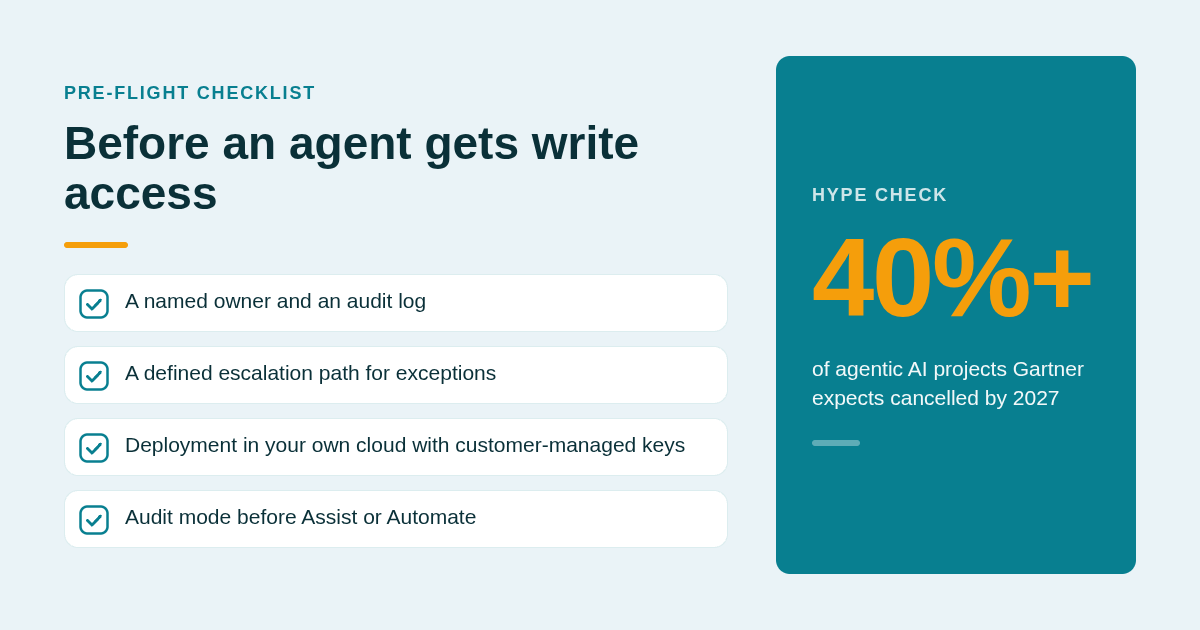
- Hype check: Gartner predicted in June 2025 that more than 40% of agentic AI projects will be cancelled by the end of 2027, citing rising costs, unclear business value and weak risk controls.
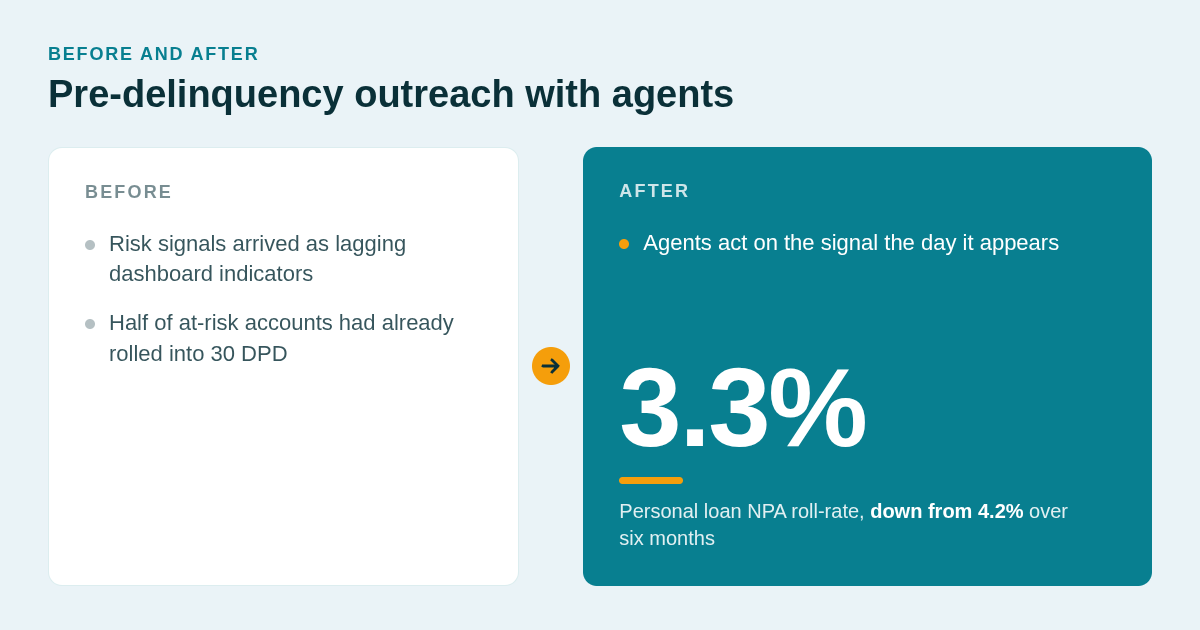
- Evidence it works: Actioneer's risk and portfolio case study reports a personal loan NPA roll-rate falling from 4.2% to 3.3% over six months after agents took over pre-delinquency outreach.
- Decision rule: an AI agent beats simpler automation only when the workflow needs judgment inside a conversation, spans several channels or days, and ends in an outcome you can count.
- Enablers: interoperability standards such as the Model Context Protocol, plus agent-specific security controls, decide how fast AI agents reach mainstream enterprise adoption.

Is the AI agent boom real adoption or mostly hype?
AI agent adoption is real but narrower than the headlines suggest. McKinsey's 2025 State of AI survey found 23% of organisations scaling an agentic AI system in the enterprise, while Gartner predicts more than 40% of agentic AI projects will be cancelled by the end of 2027. Both facts hold at once: genuine deployments alongside widespread failed pilots.
The cancellation forecast comes from a Gartner press release published in June 2025, which as of November 2026 remains the most cited sceptical data point on agents. Gartner's analysts also warned about "agent washing," the practice of relabelling chatbots and RPA scripts as agents, and estimated that only about 130 of the thousands of self-described agentic vendors were real.
The adoption signal is just as concrete. In McKinsey's 2025 State of AI survey, 23% of respondents reported scaling an agentic AI system somewhere in their enterprise, and a further 39% said they had started experimenting. As of November 2026, that is the clearest published picture of how many companies have moved past demos.
Our reading of both numbers is that the question is scoped wrong. Agents are not failing as a category; broad, loosely defined agent programmes are failing, while narrow agents on a single workflow are getting renewed. That is the pattern we see in our breakdown of AI agents for banking operations in 2026, where each agent owns one stall point rather than a whole department.
What is an AI agent, and how does it differ from a chatbot or basic automation?
An AI agent is software that observes a trigger, plans a sequence of actions, calls tools or systems to carry them out, and checks whether the goal was met before stopping or escalating. A chatbot answers within a single conversation and waits for the next message. Rule-based automation runs fixed steps with no judgment about unexpected replies or missing data.
Three tests separate a real agent from a relabelled chatbot. First, tool use: can it read and update a system of record, not just talk about it? Second, multi-step persistence: does it keep working across hours or days without a human restarting it? Third, an escalation boundary: does it know which decisions it may not make?
A stalled loan application shows all three. On the Actioneer lending page, the agent detects an incomplete file, picks a channel from calls, SMS, WhatsApp or email, explains which document is missing, guides the borrower to the secure upload step and confirms receipt for the loan team. If the borrower asks to change loan terms, the agent hands off to the assigned loan officer rather than guessing.
What are the 7 types of AI agents?
The seven commonly cited types come from classic AI textbook taxonomy: simple reflex agents that react to a current input, model-based reflex agents that track state, goal-based agents that plan toward an objective, utility-based agents that weigh competing outcomes, learning agents that improve from feedback, hierarchical agents that split tasks across layers, and multi-agent systems where several agents coordinate.
Most enterprise agents in production as of November 2026 are goal-based agents wrapped in a learning loop. Actioneer's platform describes this as four stages per customer: Know, Act, Measure and Learn. The practical lesson is that the type matters less than whether the goal is specific enough to measure.
Which enterprise workflows are AI agents already changing?
AI agents are already changing customer follow-up, collections and pre-delinquency outreach, document collection, appointment recovery and sales prioritisation. The common thread is a high-volume task that staff currently chase by hand. In Actioneer's risk and portfolio case study, a lender's personal loan NPA roll-rate fell over six months once agents handled pre-delinquency outreach.
That result is the kind of evidence most "future of agents" articles leave out. Before the deployment described in the risk and portfolio operations case study, pre-delinquency signals were lagging indicators: by the time a dashboard refreshed, half of the at-risk accounts had already rolled into 30 days past due. The agent's job was to act on the signal the day it appeared.
Operations and cost reduction look similar. In Actioneer's distribution case study, relationship managers had been pulling their own call lists from daily Excel exports, roughly 6 hours of analyst-equivalent work per RM per week, and the cross-sell take rate rose once agents prioritised the lists. Customer service and marketing automation are the other two adoption drivers, and the same rule applies: the value lands where a task was previously chased manually.
This is also where the vertical versus general-purpose debate resolves. General assistants are good at drafting and summarising; specialised agents are good at finishing regulated tasks because they know the document checklist, the compliance script and the handoff point. Sierra's published financial services deployments with SoFi and Chime show inbound service across several products, while Actioneer's agents concentrate on outbound follow-through, a difference we examine in our Actioneer versus Sierra comparison for banking customer service.
Why do AI agent projects fail, and what makes the successful ones different?
AI agent projects fail when the workflow has no clear trigger, no measurable finish line and no defined escalation boundary, so nobody can tell whether the agent did its job. Successful rollouts start with one stall point, one site and three measurements: how many customers complete the step, how long it takes, and how many staff follow-ups each case needs.
Gartner's three stated reasons for cancellations, rising costs, unclear business value and inadequate risk controls, all trace back to scope. An agent asked to "handle customer service" cannot be measured; an agent asked to recover applications that stalled at document upload can. The pilot design we use with lenders is deliberately small: pick one branch and one point where applications regularly stall, then count completions, elapsed time and follow-ups per file. A reply from a borrower is encouraging. A borrower completing the step that held up the loan is the outcome worth measuring.
The second difference is evaluation before deployment. Actioneer publishes its research on multi-step reasoning and evaluation, including its score on DABstep, the benchmark from Hugging Face and Adyen built from 450 multi-step tasks on real financial data, with results reported for both the overall set and the hard set as of November 2026. The DABstep leaderboard on Hugging Face lets anyone check how other systems score on the same tasks.
We would add an honest caveat: benchmark accuracy is not production reliability. The remaining tasks a model gets wrong are exactly why every agent needs an escalation boundary and a human owner for exceptions, which is the point of running agents in Audit mode before Assist or Automate.
When should a small business pick an AI agent over simpler automation?
Use a three-question rule. Does the task require reading an unpredictable reply and deciding what to do next? Does it span more than one channel or more than one day? Can you count the outcome, such as documents received or appointments kept? If any answer is no, a scheduled reminder or a workflow tool is cheaper and easier to govern.
A worked example: a clinic that sends one appointment reminder by text needs automation, not an agent. A clinic that must reach patients who missed a visit, answer their rescheduling questions, verify identity, book the new slot and confirm it, across calls and messages over several days, has an agent-shaped problem.
What has to happen before AI agents become the enterprise operating layer?
Three enablers decide how fast AI agents become the operating layer for enterprise software: interoperability standards such as the Model Context Protocol so agents can call any system, security controls that treat prompt injection and runaway agents as first-class threats, and inference costs low enough that running an agent per customer interaction pays for itself.
Interoperability is moving fastest. The Model Context Protocol, open-sourced by Anthropic in November 2024, gives agents a standard way to connect to data sources and tools, and as of November 2026 it is the most widely referenced open standard for agent integrations. Standards like this matter because an agent that cannot reach your loan origination system cannot finish a loan task.
Security is the enabler most often skipped. The OWASP Top 10 for Large Language Model Applications ranks prompt injection as the leading risk, and an agent with tool access turns a successful injection into an action rather than a bad answer. Shadow agent sprawl, where teams spin up agents inside SaaS tools with no inventory or owner, compounds the problem. Our decision rule: no agent gets write access to a system of record until it has an owner, an audit log and a defined escalation path.
Regulation and data residency push in the same direction. The NIST AI Risk Management Framework gives regulated firms a vocabulary for governing agents, and deployment choices make that governance practical. Actioneer, for example, runs inside the customer's own cloud account or data center, with customer-managed keys in AWS KMS, Azure Key Vault, Google Cloud KMS or an on-premises HSM, TLS 1.2 or higher in transit and AES-256 at rest, as described on its security and deployment page. Compute and power constraints favour the same design: narrow agents that wake on a trigger cost far less to run than always-on general agents.
Will AI agents replace human workers by 2035?
AI agents will replace specific tasks faster than whole jobs. Gartner predicts 15% of day-to-day work decisions will be made autonomously by agentic AI by 2028, up from zero in 2024. Roles built on chasing follow-ups shrink; roles built on judgment, exceptions and relationships keep humans, because that is exactly where well-designed agents escalate.
The same Gartner release forecasts that 33% of enterprise software applications will include agentic AI by 2028, up from less than 1% in 2024, as of November 2026 the most specific published timeline for agents as a software layer. If that holds, the interface to enterprise systems shifts from screens that humans operate to goals that agents execute.
The real estate question is a useful test. Agents can already qualify leads, schedule viewings and chase missing paperwork; they cannot negotiate a price between two anxious parties or vouch for a neighbourhood. The same split applies to customer service reps and loan officers: the follow-up work moves to agents, and the human role concentrates on credit decisions, waivers and exceptions, which is where Actioneer's lending agents route cases by design.
Longer-range forecasts that automated agents will outnumber humans online within a decade are directional rather than datable, and we treat them that way. What is already measurable is narrower and more useful: how many stalled tasks an agent finishes, and how many hours of chasing a team gets back.
How did we weigh the evidence for this post?
We compared three kinds of sources: published analyst forecasts from Gartner and McKinsey, vendor documentation including Actioneer's lending, security and research pages and Sierra's financial services customer page, and Actioneer's own published case studies for risk and distribution. We ran no survey of our own, and every number about Actioneer is taken from those published pages.
How do you get started with Actioneer?
Start with one stalled workflow, not a transformation programme. Pick a branch, a stall point and three numbers to track, then run the agent in Audit mode before letting it act. Book a demo with Actioneer and bring one real interrupted application so you can see what happens next.
What do people also ask?
Why is AI considered the future of enterprise work?
AI is considered the future of enterprise work because agents can now execute multi-step tasks across systems, not just answer questions. Gartner forecasts that 15% of day-to-day work decisions will be made autonomously by agentic AI by 2028, and McKinsey's 2025 survey found 23% of organisations already scaling an agentic system, so the shift is measurable rather than theoretical.
Is there such a thing as an AI agent, or is it just a rebranded chatbot?
Yes, a real AI agent exists, and it passes three tests a chatbot fails: it reads and updates systems of record through tools, it keeps working across hours or days without a human restarting it, and it escalates at a defined decision boundary. Gartner warned in 2025 that many vendors engage in agent washing, so ask for a live walkthrough of all three.
Will AI overtake real estate agents?
AI agents will take over the task layer of real estate work, such as qualifying leads, scheduling viewings and chasing missing documents, faster than the job itself. Negotiation, local judgment and trust between parties remain human work, which is where well-designed agents hand off rather than act.
What are the 7 types of AI agents?
The seven commonly cited types are simple reflex, model-based reflex, goal-based, utility-based, learning, hierarchical and multi-agent systems. Most enterprise agents in production as of November 2026 are goal-based agents with a learning loop, such as Actioneer's Know, Act, Measure and Learn stages for each customer.
Why do so many AI agent projects get cancelled?
Gartner attributes the more than 40% of agentic AI projects it expects to be cancelled by 2027 to rising costs, unclear business value and inadequate risk controls. In practice all three come from scope: an agent asked to handle a whole department cannot be measured, while an agent assigned to one stall point, one site and three tracked numbers can show whether it finished the task.
Related Articles



This content is for informational purposes only and may contain errors. Please contact us to verify important details.