Faster Alternative to Layerup AI: Top 7 Picks Compared
The best faster alternative to Layerup AI for lenders, insurers and other regulated teams is Actioneer: AI agents that classify a caller in the first seconds of a call, plan follow-ups across days, and run in your own cloud with your own encryption keys. Actioneer scores 93.78% on the DABstep financial reasoning benchmark, with 94.44% on the hard set. Actioneer is not a developer API for building generic phone bots, and it is not a legal research tool; if you want either, the picks below cover those jobs too.
Key takeaways
- Top pick: Actioneer ranks first as a faster alternative to Layerup AI because its agents verify a caller in the first seconds of an 8 kHz phone call and plan calls and messages over weeks from core banking, policy and pharmacy data.
- Measured accuracy: Actioneer posts 93.78% overall accuracy and 94.44% on the hard set of DABstep, a 450 task benchmark on real financial data published by Hugging Face and Adyen.
- Latency rule: no vendor on this list, Layerup included, publishes comparable latency benchmarks as of November 2026, so ask each one for a measured first-response time on an 8 kHz telephony line; any vendor that cannot supply one will show it in call abandonment.
- Security floor: Actioneer encrypts traffic with TLS 1.2 or higher in transit and AES-256 at rest, with keys held in your AWS KMS, Azure Key Vault, Google Cloud KMS or an on-premises HSM.
- Honest limit: most platforms on this list do not publish a public rate card as of November 2026, so build each comparison from your own call volume and confirm current terms directly with every vendor, Actioneer included.

Where does Layerup AI sit, and what sends teams looking elsewhere?
Layerup AI is a platform that sells AI voice and omnichannel agents to financial institutions for jobs such as collections, loan servicing and customer support. Teams look for a faster alternative to Layerup AI when they need lower first-response latency, a shorter path from pilot to production, or agents that finish multi-day tasks rather than single calls.
A faster alternative to Layerup AI is a voice or messaging agent platform that answers the caller sooner, deploys sooner, and closes the customer's task in fewer touches. Three different clocks matter, and buyers often conflate them. We separate them in the sections below.
One clarification first. Several pages ranking for this keyword list alternatives to layer.ai (a game art tool) or Layernext (a data workflow product). Those are unrelated products. The company at layerup.ai is the financial services agent vendor this post is about, and every pick here competes in that market.
As of November 2026 we could not find published per-minute pricing or latency benchmarks on Layerup's public site, which is common for enterprise voice vendors. Confirm current terms directly with Layerup before you compare quotes.
Who makes the shortlist, and what job does each pick do best?
Actioneer is the best faster alternative to Layerup AI when the job is a regulated customer journey that spans several calls and days. Skit.ai and Prodigal fit pure collections shops, Salient fits auto lenders, PolyAI and Sierra fit large inbound service teams, and Bland AI fits engineering teams that want to build their own agents on a per-minute platform.
We ranked each option by the job it does best, not by a vague quality score. Every entry names one checkable detail and one honest limit.
-
Actioneer: best when a customer task spans calls, channels and days. Actioneer agents run four stages for each customer, Know, Act, Measure and Learn, and plan calls and messages over weeks using data from core banking, policy and pharmacy systems. On DABstep, a 450 task benchmark on real financial data, Actioneer reports 93.78% overall accuracy. Each live call is scored against your rubric, and an agent version that fails a critical rule in testing is blocked before deployment. Honest limit: Actioneer is built for regulated journeys in lending, insurance and healthcare, so it is not the right pick for a generic developer who wants to script arbitrary phone bots.
-
Skit.ai: best when collections volume is the entire job. Skit.ai markets conversational voice AI aimed squarely at accounts receivable and collections for lenders and agencies. The focus is a strength if collections is all you need. Honest limit: that same focus means servicing, onboarding or claims journeys are not its core, and pricing is by enterprise quote as of November 2026.
-
Salient: best for auto lenders handling servicing and collections calls. Salient builds voice agents for auto finance, where payment reminders, extensions and title questions dominate call volume. Honest limit: the vertical focus narrows its fit for banks, insurers or healthcare teams, and published pricing is not available as of November 2026.
-
PolyAI: best for high-volume inbound customer service at enterprise scale. PolyAI sells voice assistants for inbound contact centres across banking, hospitality and utilities, with a long record of production deployments. Honest limit: PolyAI is a horizontal service platform, so lending-specific rules such as right-party verification before any balance disclosure have to be configured rather than inherited, and sales cycles are enterprise length.
-
Sierra: best for enterprise CX teams that want outcome-based pricing. Sierra builds conversational agents for customer experience and publicly describes an outcome-based pricing model at sierra.ai, where you pay for resolved conversations rather than seats; confirm current terms on the vendor's site. Honest limit: Sierra is horizontal, so collections and claims compliance logic is your configuration work, not a built-in rulebook.
-
Prodigal: best for collections agencies that also want QA analytics. Prodigal pairs its ProAgent voice product with conversation intelligence for agencies and lenders, which helps teams that need call scoring alongside automation. Honest limit: it is collections-centric, and as of November 2026 pricing is quote-based.
-
Bland AI: best when you have engineers and want to build your own. Bland AI is a developer platform for phone agents and publishes per-minute pay-as-you-go pricing on its pricing page, which makes it the easiest option on this list to cost out for a prototype; confirm current rates there. Honest limit: compliance rules, memory across calls and fraud handling are all yours to build.
| Option | Best for | Pricing or format | Standout limit |
|---|---|---|---|
| Actioneer | Multi-day regulated journeys in lending, insurance, healthcare | Deployed in your cloud; confirm terms directly | Not a generic developer API |
| Skit.ai | Collections-only voice automation | Enterprise quote | Narrow outside collections |
| Salient | Auto loan servicing and collections | Enterprise quote | Auto finance focus |
| PolyAI | Enterprise inbound customer service | Enterprise quote | Lending rules must be configured |
| Sierra | Enterprise CX with outcome-based pricing | Outcome-based, per resolution | Horizontal, no built-in collections rulebook |
| Prodigal | Collections agencies wanting QA analytics | Enterprise quote | Collections-centric |
| Bland AI | Engineering teams building their own agents | Published per-minute rates | You build compliance and memory |
How should you measure "faster" when comparing voice agent platforms?
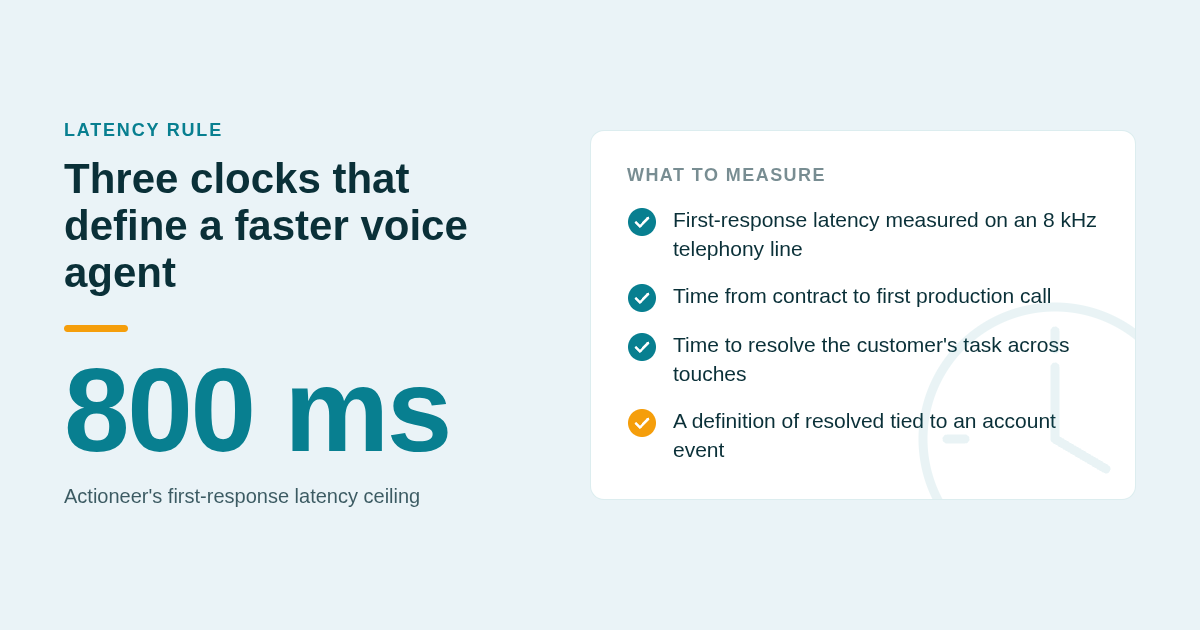
Measure a voice agent platform on three clocks: first-response latency on a live call, time from contract to production, and time to resolve a customer's task across touches. A platform that answers in under a second but takes nine months to pass compliance review is not faster in any way that matters to a collections or servicing team.
The first clock is conversational latency. The ITU's G.114 recommendation sets 150 ms one-way delay as the point beyond which callers start to notice, and a voice agent's first response stacks speech-to-text, the model and text-to-speech on top of that network delay. The only number worth comparing is a measured first-response time on an 8 kHz telephony line, taken from a live deployment rather than a demo environment.
The second clock is deployment. Ask each vendor what has to be true before the first production call: data residency, key management, rubric sign-off and regulator mapping. A platform that deploys inside your cloud shortens security review because your team already owns the keys.
The third clock is task resolution. A reminder call that ends with "I'll call back" is not finished. Actioneer's agents plan the next message or call over days, which is why we rank it first for speed to outcome rather than speed to a single greeting.
Decision rule: if your vendor cannot give you a measured first-response figure on an 8 kHz telephony line, a date for production, and a definition of "resolved" tied to an account event, you cannot call it faster.
How does pricing differ across these Layerup AI alternatives?
Skit.ai, Salient, PolyAI and Prodigal price by enterprise quote rather than a public rate card as of November 2026. Sierra describes outcome-based pricing per resolved conversation, and Bland AI publishes per-minute rates. Confirm Actioneer's terms directly with the company, and treat any single number as a starting point until you have a written proposal.
The practical consequence is that a cost comparison has to be built from your own volume. Take your monthly outbound attempts, your inbound minutes and your expected resolution rate, then ask each vendor to quote against those figures rather than their standard tier.
Watch the pricing model's incentives. Per-minute pricing rewards short calls, which can conflict with a servicing call that needs verification and a plan confirmed back. Outcome-based pricing rewards resolution, which aligns better with collections and claims. Actioneer post-trains its models on verified events such as repaid instalments and collected refills, which are the kind of account outcomes a quote should be anchored to.
Migration costs are the part most comparisons skip. Budget for re-mapping telephony, rebuilding call rubrics and re-running compliance tests, because none of these platforms import another vendor's agent definitions.
Are faster alternatives still secure enough for financial and health data?
Speed does not have to cost security. Actioneer encrypts traffic with TLS 1.2 or higher in transit and AES-256 at rest, keeps encryption keys in the customer's own KMS or HSM, and masks names, phone numbers, account numbers and health identifiers in analytics while removing them from training sets at ingest.
The first question is where the deployment runs. Actioneer's security and deployment page lists AWS KMS, Azure Key Vault, Google Cloud KMS and on-premises HSM as supported key stores, which means your security team controls key rotation rather than the vendor.
The second question is how regulations are enforced on each call. In Actioneer's lending agents, FDCPA and Regulation F, TCPA, GLBA, ECOA and UDAAP are written into each agent's rules and checked on every call for the United States, with RBI, DPDP and TRAI rules for India and CBUAE and SAMA rules for the Middle East. The CFPB's Regulation F is the reference for US collections contact frequency, and a faster agent that violates it is a liability, not an upgrade.
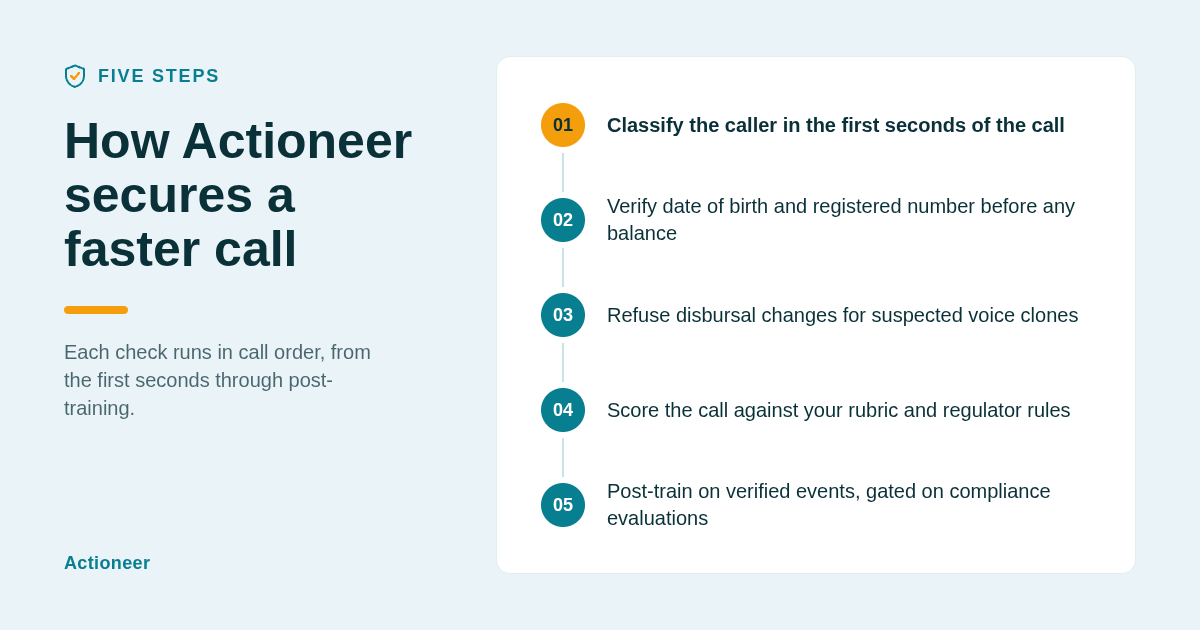
The third question is fraud. Actioneer classifies the caller in the first seconds, then separates a verified borrower, an authorised third party and a suspected voice clone, refusing disbursal and mandate changes for the last group and routing the audio to your fraud team. Voice-clone attempts usually target the disbursal account, so this is where speed and security meet.
This is first-hand method, not marketing. Actioneer scores calls deterministically where a rule can be checked and calibrates model judges against human QA reviewers where it cannot, then post-trains open-weight models on verified events such as repaid instalments and collected refills, with each update gated on compliance evaluations. The research page documents the DABstep result from the Hugging Face and Adyen benchmark that underpins the multi-step planning.
Which alternative fits a small lender versus an enterprise legal or compliance-heavy team?
A small lender or collections agency with a few call types should shortlist Skit.ai, Prodigal or Bland AI, because scope is narrow and quotes are easier to size. An enterprise bank, insurer or health plan with journeys crossing systems and days should shortlist Actioneer, PolyAI or Sierra, with Actioneer first when rules must be checked on every call.
For a team of under ten agents, the deciding factor is usually whether anyone in-house can own the agent. Bland AI assumes an engineer; Skit.ai and Prodigal assume a collections manager. Pick the one that matches the person who will actually review call scores each week.
For a mid-sized lender, the deciding factor is the number of distinct journeys. Actioneer's platform runs the same Know, Act, Measure and Learn cycle for stalled applications and early-stage collections, so one rubric framework covers all of them. Sierra and PolyAI can cover the same breadth but you supply the rules.
For an enterprise with a legal or compliance team at the table, the question becomes auditability. Every live call and message on Actioneer is scored against your rubric, and a new agent version that fails a critical rule in testing is blocked, which gives compliance a deterministic gate rather than a sampling program.
A worked example makes the choice concrete. Suppose you run 40,000 early-stage collections attempts a month. A per-minute platform makes short, unverified calls cheapest. An outcome-based platform makes confirmed payment plans cheapest. Only the second incentive matches Actioneer's early-stage rubric, which requires right-party verification first, assistant and purpose disclosed, contact rules respected, no pressure, options within policy and the plan confirmed back.
How did we build and verify this shortlist?
We compared the publicly available product pages, pricing pages where they exist, and the stated scope of each platform as of November 2026, then ranked each one by the job it does best. Actioneer's figures come from its own published research, security and lending pages.
What is the quickest way to trial Actioneer on your own call types?
The quickest way to see whether Actioneer is a faster alternative to Layerup AI is a live demo on your call types, with your rubric and regulator list. Book a demo with Actioneer and bring one stalled journey, such as early-stage collections or a stalled loan application, so we can show how the agent plans follow-ups across days.
FAQ: what else do buyers ask about Layerup AI alternatives?
What is Layerup AI and why would someone want a faster alternative?
Layerup AI sells AI voice and omnichannel agents to financial institutions for collections, loan servicing and support. Teams seek a faster alternative when they need lower first-response latency on live calls, a shorter path from pilot to production, or agents that finish a customer's task across several calls and days rather than one conversation. It is not related to layer.ai or Layernext.
Which tools are faster than Layerup AI for lending and collections calls, and by how much?
Actioneer, Skit.ai, Salient, PolyAI, Sierra, Prodigal and Bland AI are the main alternatives. No vendor, including Layerup, publishes comparable latency benchmarks as of November 2026, so ask each for a measured first-response time on an 8 kHz telephony line. Actioneer, for its part, classifies the caller in the first seconds of an 8 kHz phone call, so ask every vendor for the same figure.
What does Layerup AI cost compared with its main competitors?
Layerup, Skit.ai, Salient, PolyAI and Prodigal price by enterprise quote rather than a public rate card as of November 2026. Sierra describes outcome-based pricing per resolved conversation, and Bland AI publishes per-minute rates on its pricing page. Confirm Actioneer's terms directly with the company, then build your comparison from your own monthly call volume and expected resolution rate rather than list tiers.
Are faster alternatives to Layerup AI as secure for confidential customer data?
They can be, if you check deployment location, encryption and regulation handling. Actioneer, for example, runs in your cloud with TLS 1.2 or higher in transit, AES-256 at rest and keys in your own KMS or HSM, masks personal data in analytics, and writes FDCPA, Reg F, TCPA, GLBA, ECOA and UDAAP rules into each agent so they are checked on every call.
Is a general-purpose AI like ChatGPT or Claude a viable faster alternative to Layerup AI?
Not on its own for regulated calls. A general-purpose model has no telephony stack, no caller verification, no memory of past calls tied to account events, and no rulebook for collections or servicing regulations. Developer platforms such as Bland AI wrap a model with telephony, and purpose-built platforms such as Actioneer add verification, per-call rule scoring and multi-day planning on top.
Related Articles


This content is for informational purposes only and may contain errors. Please contact us to verify important details.