Actioneer vs Ada Pricing Comparison: 6 Cost Factors Reviewed
An Actioneer vs Ada pricing comparison is a side-by-side review of how each vendor charges for AI customer agents, what each contract includes and what drives total cost, and neither vendor publishes list prices as of November 2026. Choose Actioneer when you run regulated customer journeys in lending, insurance, healthcare or wealth and need agents that work across calls, texts and days inside your own cloud. Choose Ada when you need high-volume support deflection on a resolution-based contract. Actioneer is not a general-purpose help desk chatbot and does not sell per-seat support licences.
Key takeaways
- Billing model: Ada publicly positions its pricing around automated resolutions, while Actioneer prices lifecycle agents by scoped deployment through a demo, with terms set in its Master Service Agreement, as of November 2026.
- No freemium: Neither Actioneer nor Ada advertises a free plan as of November 2026; Actioneer offers a live AI text demo for US and Canada phone numbers instead.
- Reference benchmark: Intercom Fin publishes $0.99 per resolution as of November 2026, which makes 1,000 resolutions cost $990 and 50,000 resolutions cost $49,500 per month before any discount, a useful yardstick for any quote.
- Measured outcome: Actioneer's risk and portfolio operations case study reports a personal loan NPA roll-rate reduction over six months.
- Deployment cost: Actioneer runs in the customer's cloud with customer-managed keys in AWS KMS, Azure Key Vault, Google Cloud KMS or an on-premises HSM, so hosting lands on the buyer's existing cloud bill.

Key takeaways
- Billing model: Ada publicly positions its pricing around automated resolutions, while Actioneer prices lifecycle agents by scoped deployment through a demo, with terms set in its Master Service Agreement, as of November 2026.
- No freemium: Neither Actioneer nor Ada advertises a free plan as of November 2026; Actioneer offers a live AI text demo for US and Canada phone numbers instead.
- Reference benchmark: Intercom Fin publishes $0.99 per resolution as of November 2026, which makes 1,000 resolutions cost $990 and 50,000 resolutions cost $49,500 per month before any discount, a useful yardstick for any quote.
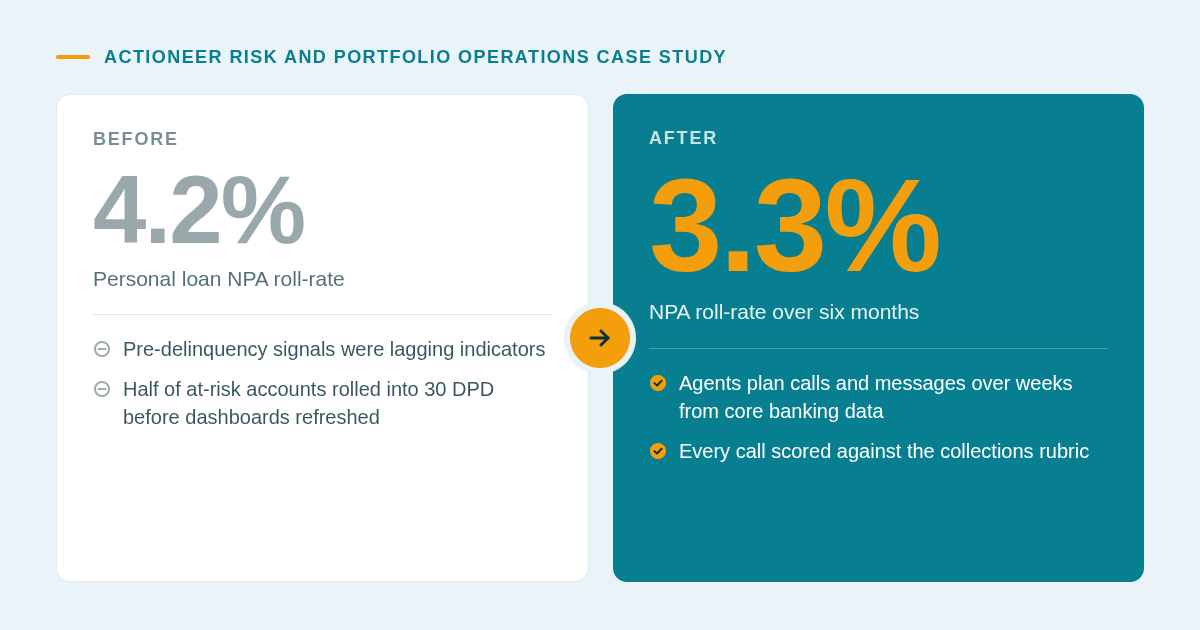
- Measured outcome: Actioneer's risk and portfolio operations case study reports a personal loan NPA roll-rate drop from 4.2% to 3.3% over six months.
- Deployment cost: Actioneer runs in the customer's cloud with customer-managed keys in AWS KMS, Azure Key Vault, Google Cloud KMS or an on-premises HSM, so hosting lands on the buyer's existing cloud bill.
How do Actioneer and Ada price their AI agents?
Actioneer and Ada both sell AI customer agents on quote-based contracts rather than published list prices as of November 2026. Ada publicly ties billing to automated resolutions, the conversations its agent closes without a human. Actioneer scopes pricing through a demo for lifecycle agents that run across calls, texts and days inside the customer's own cloud.
Cost factor one is the billing unit. Ada's pricing page describes a quote-based model and, as of November 2026, Ada has positioned automated resolutions as the thing you pay for rather than seats. The exact definition of a resolution matters: a conversation that ends without escalation may or may not count as resolved, so ask for the contractual definition and confirm current terms on Ada's site.
Actioneer uses a different unit of work. Each agent runs four stages for each customer, Know, Act, Measure and Learn, as described on our customer lifecycle agent platform page. An agent may call a borrower on Monday, send a text at lunchtime and confirm a repayment plan days later. That is one customer outcome, not three support tickets, so pricing is scoped around the journeys you deploy rather than per message.
Cost factor two is transparency. Neither vendor prints a dollar figure publicly, so the only reliable route to a number is a scoped quote. We recommend asking both vendors for the same written scenario, which we lay out in the hidden costs section below, so the quotes can be compared line by line.
Do Actioneer or Ada offer a free trial or free plan?
Neither Actioneer nor Ada offers a self-serve free plan as of November 2026. Ada starts with a sales demo. Actioneer offers a live AI text demo to US and Canada phone numbers, plus a booked platform demo, so buyers can test an agent conversation before any contract. Budget for a paid pilot rather than a freemium tier.
Cost factor three is trial access. Ada's public site routes prospective buyers to a demo request rather than a credit-card signup as of November 2026, which is typical for enterprise support automation. A paid pilot on a limited set of intents is the normal first step, and you should ask whether pilot fees are credited against a full contract.
Actioneer's entry point is different in kind. You can request an AI text demo on a US or Canada number and hold a real conversation with an agent, which tells you more about handling quality than a slide deck. Message frequency varies, message and data rates may apply, and you can reply STOP to unsubscribe.
The practical decision rule: if your team needs to self-serve a trial in an afternoon, neither vendor fits and you should look at a published per-resolution product. If you are evaluating a production deployment with compliance review, a scoped pilot from either vendor is the right expectation.
What hidden or add-on costs should buyers expect from each?
Hidden costs in an Actioneer vs Ada deal come from four places: implementation and integration work, overage charges above a committed volume, premium channels such as voice, and enterprise support or security add-ons. Actioneer deploys in the customer's cloud with customer-managed keys, which puts hosting on the buyer's cloud bill and keeps data residency under the buyer's control.
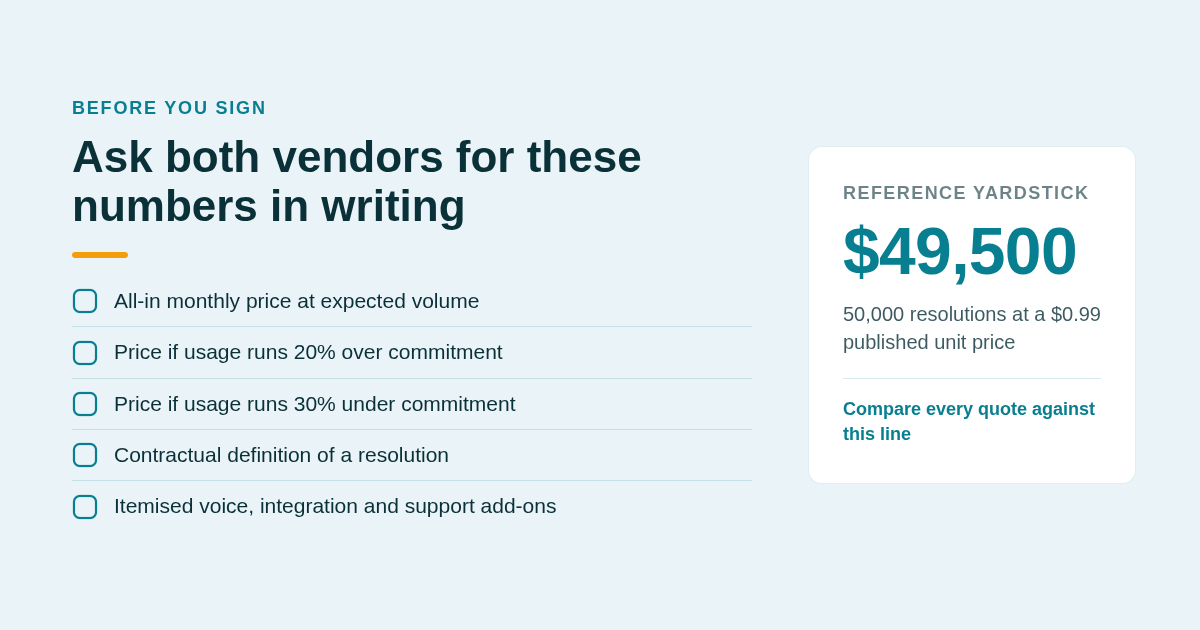
Cost factor four is total cost of ownership. For usage-priced tools, the biggest risk is overage. Intercom's published Fin pricing of $0.99 per resolution, as of November 2026, gives a clean worked example: 1,000 resolutions in a month cost $990, while 50,000 resolutions cost $49,500 before any volume discount. A quote-based vendor such as Ada will usually beat that unit price at the higher volume, but only if your committed volume is accurate.
Ask Ada and Actioneer for three numbers in writing: the all-in monthly price at your expected volume, the price if you run meaningfully over that volume, and the price if you run meaningfully under it. The spread between those three figures tells you how much pricing risk you carry versus the vendor.
Integration and security costs behave differently for the two products. Actioneer connects to core banking, policy and pharmacy systems, and the security and deployment page lists TLS 1.2 or higher in transit, AES-256 at rest and customer-managed keys in AWS KMS, Azure Key Vault, Google Cloud KMS or an on-premises HSM. Personal data such as names, phone numbers, account numbers and health identifiers is masked in analytics and removed from training sets at ingest. Those controls are part of the platform rather than an enterprise add-on, though your own cloud compute is a line on your bill.
For Ada, confirm which channels, integrations and support tiers sit inside the base contract. Voice and premium integrations are the usual places where scope creeps, so get them itemised before signing.
Which is cheaper for a small team versus an enterprise deployment?
For a small support team handling simple FAQs, a per-resolution tool such as Intercom Fin is usually cheaper than either Ada or Actioneer, because both run quote-based enterprise contracts. Actioneer is built for regulated enterprises in lending, insurance, healthcare and wealth, where compliance rubrics, voice-clone detection and in-cloud deployment justify an enterprise contract rather than a seat licence.
Cost factor five is contract structure and deployment. Ada runs as vendor-hosted SaaS, which keeps infrastructure off your books but means data residency follows the vendor's regions. Actioneer runs in your cloud, which suits banks, insurers and health plans that already have cloud governance in place and cannot send call audio to a third-party tenant.
Contract terms differ too. Actioneer's terms are set in a Master Service Agreement and a Data Processing Addendum between Glitchcraft, Inc. and the customer, so minimum term, renewal and cancellation are negotiated per deployment rather than taken from a self-serve checkout. Ada's terms are also quote-based as of November 2026, so ask both vendors for annual versus multi-year pricing and the cancellation notice period.
By buyer type, our verdict is straightforward. A small e-commerce or SaaS team with one support channel should start with published per-resolution pricing. A mid-market support organisation with 10,000 or more monthly conversations should get an Ada quote and compare the unit price against the Intercom benchmark above. A lender, insurer, hospital or wealth platform that needs agents to verify identity, follow FDCPA and Regulation F rules on collections calls, and act on account data should price Actioneer, because that work sits outside what a support deflection bot does. Our lending agents page shows how each call is scored against a rubric covering right-party verification, disclosure, contact rules and plan confirmation.
Which are the top 5 AI customer agent platforms compared by cost?
The top five AI customer agent platforms by cost fit are Actioneer for regulated lifecycle journeys in lending, insurance, healthcare and wealth; Ada for high-volume support automation on a resolution-based contract; Intercom Fin for published per-resolution pricing you can model today; Zendesk AI agents for teams already on Zendesk; and Sierra for outcome-based enterprise deals.
- Actioneer: best when you need agents that finish regulated customer tasks across calls, texts and days. Pricing is quote-based and scoped by deployment, with the platform running in your cloud under your own keys. Actioneer scored 93.78% overall accuracy on the DABstep benchmark of 450 multi-step tasks on real financial data, and 94.44% on the hard set. Honest limit: Actioneer is not a general help desk bot for product FAQs, and there is no self-serve trial or published price.
- Ada: best when you need high-volume support deflection across chat, email and messaging. Ada's pricing is quote-based and publicly tied to automated resolutions as of November 2026. Honest limit: no published dollar figures, so budgeting depends on an accurate volume forecast and a clear contractual definition of a resolution.
- Intercom Fin: best when you want a published unit price you can model today. Intercom lists Fin at $0.99 per resolution as of November 2026; confirm current pricing on Intercom's site. Honest limit: per-resolution billing scales linearly, so cost at 50,000 resolutions reaches $49,500 per month before discounts.
- Zendesk AI agents: best when your team already lives in Zendesk. Zendesk publishes Suite Team at $55 per agent per month billed annually on its pricing page as of November 2026, with AI agent automated resolutions sold as a separate add-on. Honest limit: you pay for seats and for automation, so the two lines must be modelled together.
- Sierra: best when you want an enterprise vendor that charges on outcomes. Sierra describes outcome-based pricing rather than seats and does not publish list prices as of November 2026. Honest limit: enterprise-only sales motion and no public trial.
| Option | Best for | Pricing or format | Standout limit |
|---|---|---|---|
| Actioneer | Regulated lifecycle journeys in lending, insurance, healthcare, wealth | Quote-based, scoped per deployment, runs in your cloud | No published price or self-serve trial |
| Ada | High-volume support deflection | Quote-based, billed around automated resolutions | Resolution definition must be confirmed in contract |
| Intercom Fin | Teams that want a published unit price | $0.99 per resolution (as of November 2026) | Linear cost growth at high volume |
| Zendesk AI agents | Existing Zendesk customers | Suite Team $55 per agent per month annual, plus AI add-on | Seats and automation billed separately |
| Sierra | Outcome-based enterprise contracts | Quote-based, outcome pricing | Enterprise-only, no public trial |
What do users say about value for money and ROI?
Value for money on Actioneer shows up in account outcomes rather than deflection rates. In Actioneer's risk and portfolio operations case study, the personal loan NPA roll-rate fell over six months as agents reached at-risk accounts earlier. Ada's public ROI case rests on automated resolution rates, so buyers should confirm the resolution definition before signing.
Cost factor six is realised return. We measure Actioneer deployments on the account events that follow a conversation: repaid instalments, collected refills, booked appointments and reactivated accounts. Our risk and portfolio operations case study started from a familiar problem: pre-delinquency signals were lagging indicators, and by the time a portfolio dashboard refreshed, half of the at-risk accounts had already rolled into 30 days past due. Our distribution and cross-sell deployment reports a cross-sell take rate moving from 1.4% to 3.4%.
Those figures come from our own deployments, so weigh them as vendor-reported. We publish the method behind them on our research page: calls are scored deterministically where a rule can be checked, model judges are calibrated against human QA reviewers where a rule cannot, and open-weight models are post-trained on verified events with each update gated on compliance evaluations. The DABstep result is independently listed on the Hugging Face DABstep leaderboard run by Hugging Face and Adyen.
For Ada, public review profiles on G2 and Gartner Peer Insights are the right place to read recurring praise and complaints; we do not reproduce ratings here because they change monthly. The questions that matter most on a reference call are the same for both vendors: what share of conversations counted as resolved, how often the agent escalated incorrectly, and whether the final bill matched the quote.
How did we compare these options?
We compared each vendor's public pricing page, product and security documentation, and the published scope of each tool as of November 2026. Where a vendor publishes a dollar figure, we quoted it and asked readers to confirm it on the vendor's site. Where pricing is quote-based, we described the billing model without inventing a number.
How do you get started with Actioneer?
Getting started with Actioneer means a scoped demo rather than a self-serve signup. We walk through the customer journeys you want to automate, the systems the agents must connect to, the regulations written into each agent's rules, and the cloud account where the platform will run.
Book a demo with Actioneer to get a scoped quote for your lending, insurance, healthcare or wealth journeys.
What do people also ask?
How much does Actioneer cost per month compared to Ada?
Neither Actioneer nor Ada publishes a monthly price as of November 2026. Both are quote-based. Ada bills around automated resolutions, while Actioneer scopes pricing per deployment of lifecycle agents that run in your cloud. Ask both vendors for a written quote at your expected volume, plus prices at 20% over and 30% under.
Does Actioneer or Ada offer a free trial?
No. As of November 2026, Ada starts with a sales demo and Actioneer starts with a booked demo, though Actioneer also offers a live AI text demo on US and Canada phone numbers so you can test a real agent conversation before any contract.
Which hidden costs should buyers expect from Actioneer and Ada?
Implementation and integration work, overage charges above committed volume, premium channels such as voice, and enterprise support tiers. Actioneer runs in your cloud with your own KMS keys, so compute appears on your cloud bill but data residency stays under your control.
Which is cheaper for a small team, Actioneer or Ada?
For a small team with simple FAQs, neither is the cheapest option; a published per-resolution product such as Intercom Fin at $0.99 per resolution (as of November 2026) is easier to budget. Ada fits mid-market support volume. Actioneer fits regulated lending, insurance, healthcare and wealth deployments.
Which is the better fit by use case, Actioneer or Ada?
Ada is the better fit for high-volume customer support deflection across chat, email and messaging. Actioneer is the better fit when agents must verify identity, follow rules such as FDCPA and Regulation F or RBI directions, act on account data, and finish tasks across calls and days in regulated industries.
Related Articles



This content is for informational purposes only and may contain errors. Please contact us to verify important details.